
Key Takeaways: Why Your CRM Is Collecting Dust (And What Actually Fixes It)
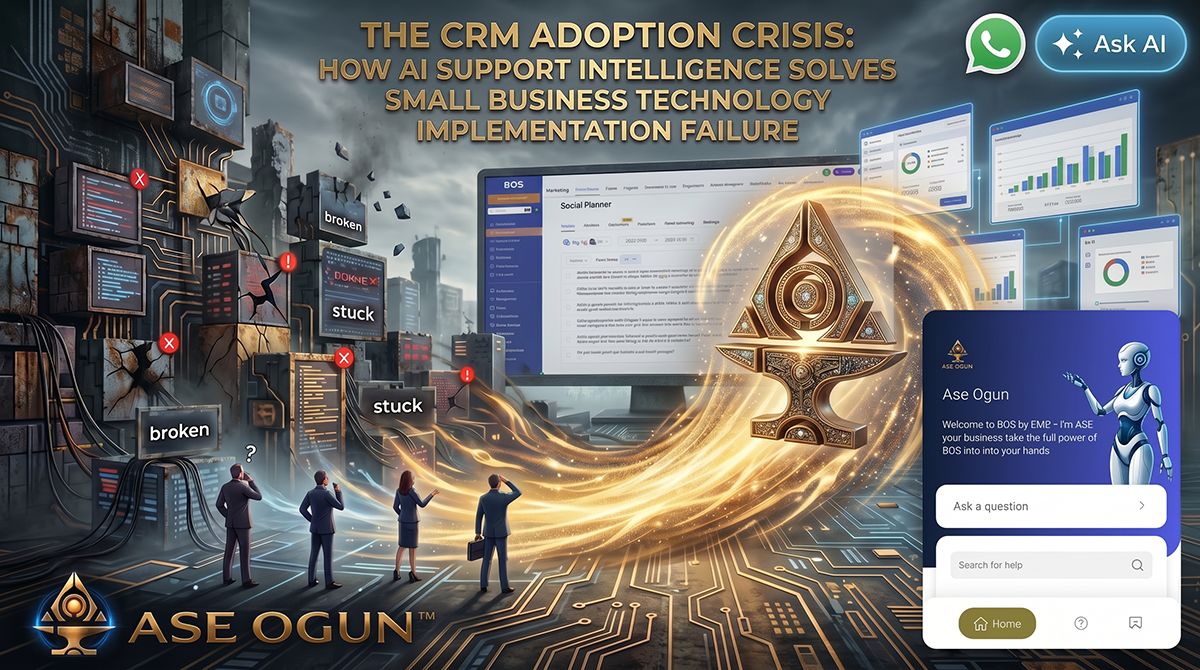
- 73% of CRM implementations fail to achieve their objectives — and the technology itself is rarely the reason. The real crisis is adoption, and it’s costing small businesses thousands in wasted investment.
- There are three distinct gaps that silently kill CRM adoption in small businesses: the Knowledge Gap, the Training Capacity Gap, and the Resistance Gap — and most agencies never address any of them after go-live.
- ASE OGUN, the AI Support Intelligence engine built into the Ethos Media Marketing & Consulting (EM2-BOS) platform, is not a chatbot or a help widget — it’s the intelligence layer that turns marketing technology into operational power your team will actually use.
- Traditional onboarding models — one-time training, PDF libraries, 48-hour support tickets — are structurally broken and designed in a way that almost guarantees your team will retreat back to spreadsheets within 90 days.
- The businesses that win aren’t the ones with the best software. They’re the ones whose teams actually use the software — and that requires living infrastructure, not shelf-ware.
You Don’t Have a CRM Problem. You Have an Adoption Problem.
Picture this: It’s 90 days after you signed the contract, paid the setup fees, and sat through the onboarding calls. The CRM is technically live. The pipeline is set up. The automations are built. But when you walk through the office — or check in on your remote team — everyone is quietly working from the same Google Sheet they’ve always used. Nobody mentions it. You don’t bring it up. And that $12,000 investment slowly turns into the most expensive piece of digital furniture you’ve ever bought.
It’s not a unique situation. As per studies and industry analysis, 73% of CRM implementations do not meet their stated goals. For small businesses, nonprofits, and professional service firms, that failure rate directly translates into lost income, halted growth, and a growing doubt that technology can even assist them. The frustration is genuine and justified — but the diagnosis is almost always incorrect.
The $12,000 Software That No One Uses
The money is not the worst part. The most painful part is the missed opportunities. The leads that were lost because no one logged the follow-up, the customer relationships that went cold because the nurture sequence was never activated, the deals that were stalled because the pipeline report was too confusing to pull. When a CRM is not used, it does not just sit quietly. It actively costs you because you are still running the manual processes you were running before, but now with an extra subscription fee attached to them.
73% of CRM Implementations Fail — And It’s Not the Technology’s Fault
The platforms themselves — GoHighLevel, HubSpot, Salesforce, and others — are genuinely powerful tools. They’re built by large engineering teams, refined over years, and capable of automating entire departments worth of work. The software isn’t the problem. What’s missing is the bridge between a technically functional system and a team that confidently operates inside it every single day. That bridge has a name, and most agencies never build it.
The True Cause of Small Business Technology Failure
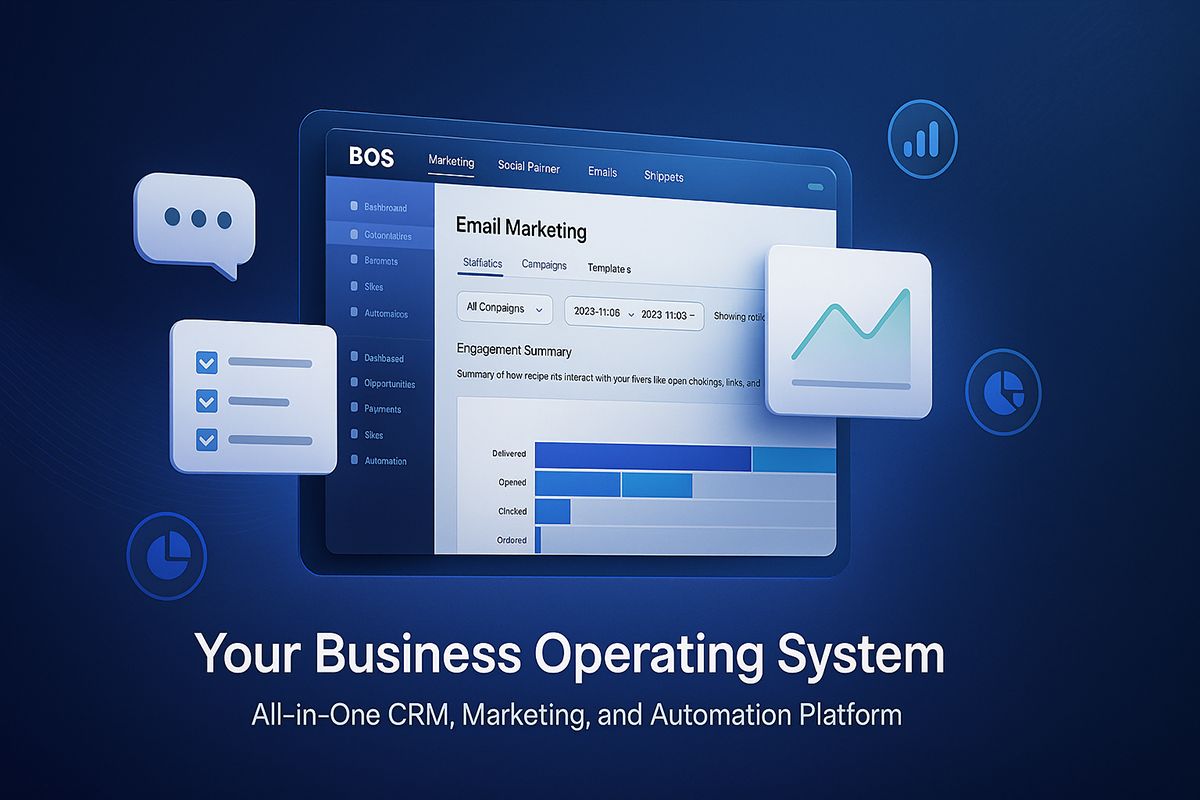
The cause is an adoption gap — specifically, three distinct gaps that compound on each other until the system collapses under its own weight. Understanding these gaps isn’t just theoretical. Each one represents a specific point where revenue leaks, growth stalls, and the Authority Ceiling gets lower. You can’t scale without systems. But systems without support create the chaos that stalls growth. That’s the insight most technology vendors and marketing agencies never tell you, because solving it requires more than handing over login credentials and a welcome packet.
The Root Cause: Three Hurdles That Sabotage CRM Adoption
CRM adoption failure doesn’t just occur suddenly. It happens subtly and gradually — a question left unanswered, a workaround that becomes a habit, a feature that gets avoided because nobody knows how it works. By the time you realize your team isn’t using the system, the patterns are already ingrained. Here’s where the problem really begins.
Gap 1: The Knowledge Gap — Unawareness of Unawareness
Your sales coordinator logs into the CRM to add a new lead. She stares at the screen for 45 seconds, then opens a chat to ask: “Wait, should I tag this as a prospect or an opportunity? And where does the intake form response go?” Nobody answers right away. She moves on, adds the contact without the tag, and the automation that should have triggered a welcome sequence never fires. That lead sits cold for a week. This is the Knowledge Gap in action — not a lack of intelligence or effort, but a lack of contextual, in-the-moment guidance. It’s the gap between what the system can do and what any given user knows how to do right now.
Gap 2: The Training Capacity Gap — You’re Too Busy Running a Business to Become a CRM Trainer
So your team has questions. They come to you. You answer them — the first time, the second time, maybe even the fifth time. But you’re also running client calls, managing cash flow, reviewing proposals, and trying to actually grow the business. You become the reluctant help desk, and every CRM question costs you 10–15 minutes of context-switching. Eventually, you stop responding as quickly. Your team stops asking. They find their own workarounds instead — usually involving a spreadsheet. The Training Capacity Gap isn’t about unwillingness. It’s about a structurally impossible expectation that the business owner will absorb the role of full-time CRM trainer on top of everything else.
Gap 3: The Resistance Gap — The Pull Back to Comfortable Chaos
The third gap is the most dangerous because it’s the least visible. Resistance to new systems rarely looks like open defiance. It looks like a team member who “forgets” to log calls in the CRM. It looks like a sales rep who keeps their prospect notes in a personal notebook. It looks like an account manager who insists the old email thread method is “just faster.” This is silent sabotage through non-adoption, and it’s not a character flaw — it’s a predictable human response to systems that feel complicated, unsupported, and foreign. When people don’t feel confident in a tool, they avoid it. And every day they avoid it, the habit of avoidance gets stronger.
Why Systems Without Support Create More Problems: The Authority Ceiling
Authority is constructed through infrastructure — but infrastructure without ongoing support becomes a liability instead of an asset. Every business hits an Authority Ceiling: the point where your growth stalls because your operations can’t support the next level of scale. Most small business owners assume this ceiling is about strategy, offer, or marketing. In reality, it’s usually about systems — specifically, systems that exist on paper but aren’t functioning in practice. Closing the three adoption gaps isn’t a nice-to-have. It’s the structural work that determines whether your technology investment compounds or collapses.
Why the Old Way of Onboarding Doesn’t Work
The typical onboarding process for a software vendor or agency is pretty predictable: it starts with a kickoff call, then a few setup sessions, maybe a recorded walkthrough, and then you’re on your own. They give you a login, a URL for the help center, and an email for support. And that’s it. They’re assuming that a few hours of training at the beginning will be enough to get your entire team through weeks, months, and years of actually using the system. But it’s not. And deep down, everyone knows it’s not.
Why the One-Time Training Model is Flawed
When it comes to simple, static tools, one-time training is sufficient. However, this approach falls short when it comes to complex, multi-feature platforms like modern CRM and marketing automation systems. The reason is simple: people can’t remember information that they can’t immediately use. A two-hour onboarding session might cover features that your team won’t need for another three months. By the time they need those features, they’ll have forgotten everything they learned. Numerous studies on learning retention have shown that without reinforcement and contextual practice, most of the training content is forgotten within days.
Staff turnover only makes the problem worse. Every time someone leaves the team and a new person is hired, you have to start the training process all over again. There’s no built-in institutional knowledge in the system — it’s all in the minds of whoever was there for the original onboarding calls.
Manuals That No One Has Time to Read
Most platforms try to make up for the shortcomings of one-time training by creating libraries of documentation: knowledge bases, PDF guides, video tutorials, FAQs. These are great resources in theory. But in practice, they become what’s euphemistically referred to as a documentation graveyard — a huge repository of content that almost no one reads, that takes 20 minutes to find a 30-second answer in, and that becomes obsolete every time the platform updates its interface.
Imagine one of your employees is talking to a client and needs to know how to merge two contact records quickly. They’re not going to stop what they’re doing to open a 47-page PDF. They’re going to ask someone else or give up. The documentation model assumes that people will stop their work, find the answer, read it, and apply it correctly. That doesn’t happen in most real-world work situations.
Two-Day Email Support Delays That Squash Progress
Put in a support ticket. Wait for a reply. Receive a reply that doesn’t fully address your question. Respond with more details. Wait some more. This pattern is the typical experience with most software support systems — and for small businesses where progress is crucial, a two-day delay on a simple question can result in a lead that goes stale, an automation that misfires for two days, or a team member who has already found a workaround that disrupts the whole system logic.
Time is of the essence in business. This is not because small business owners are impatient, but because the cost of a blocked team member compounds quickly. Every hour someone can’t complete a task in the CRM is an hour they’re either waiting, improvising, or reverting to old habits. The support ticket model was never designed with that operational reality in mind.
The Perilous Middle Ground: Just Enough Knowledge to Be Dangerous
When you combine insufficient training, unhelpful documentation, and slow support, you end up with a team that is in the worst possible position: they have enough knowledge to use the system, but not enough to use it properly. They can log contacts, but they tag them incorrectly. They can create automations, but the logic is flawed. They know the CRM is there and should be used, but they’ve silently bypassed the parts that they don’t understand. Your team learns just enough to be dangerous, then hits a roadblock and gives up — and the system that was supposed to bring order starts to create its own form of disorder.
Meet ASE OGUN: It’s Smart, Not Just Software
This is where the game changes completely. It’s not about a new feature. It’s not about a better onboarding checklist. It’s about a completely different way of thinking about how to support a business through technology implementation — a philosophy that’s been built into the infrastructure from the very beginning. Discover what sets business operating systems apart in this evolving landscape.
Understanding ASE OGUN (And What It Is Not)
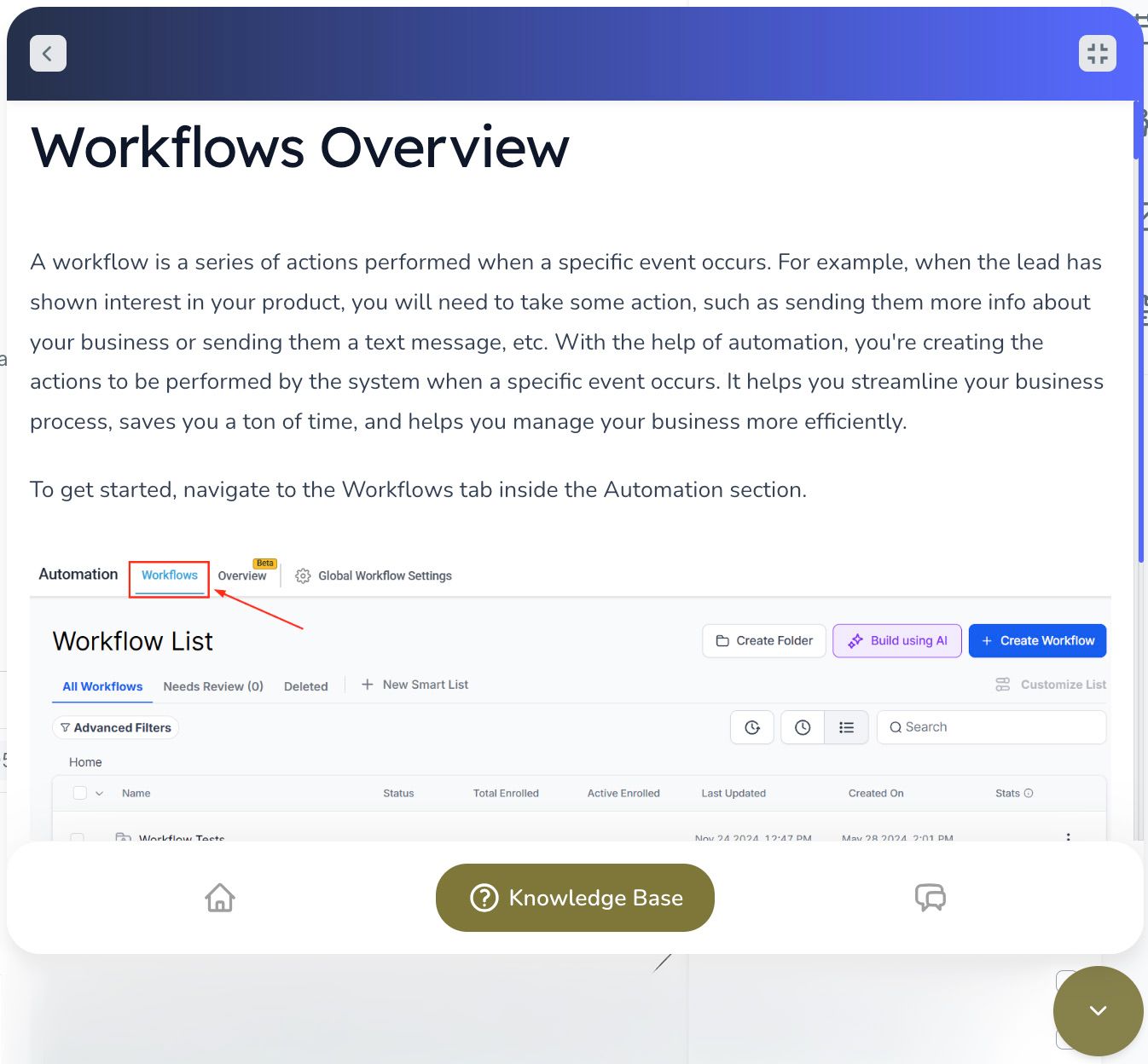
Let’s be clear about this, because the difference matters a lot. ASE OGUN is not a chatbot. It is not a support widget, an AI aid, or a customer service bot attached to a platform. Those tools respond to general questions with general answers. ASE OGUN is something fundamentally different: it is the intelligence engine integrated into the EM2-BOS operating system — a dynamic infrastructure that facilitates adoption by providing the right guidance, in the right context, exactly when your team needs it.
1. Instant, In-System Answers When Your Team Needs Them Most
When a team member encounters a problem in the CRM, that’s when adoption either holds or breaks. With ASE OGUN, that moment doesn’t become a bottleneck. Instead of opening a support ticket, searching through a documentation library, or interrupting the business owner, your team member gets a direct, specific answer — instantly, inside the system where they’re already working. No tab-switching. No waiting. No guessing.
This isn’t just about making things easier. It’s about keeping things moving. When you can answer a question in 30 seconds instead of waiting two days, everything keeps moving. The lead is properly tagged. The automation is triggered. The follow-up email is sent on time. CRM support for small businesses that works this fast doesn’t just make things less frustrating—it changes the game in terms of what you can do on a day-to-day basis.
2. Context-Aware Guidance That Meets Users Where They Are
Generic help content answers generic questions. ASE OGUN, however, is different. It is trained specifically on your EM2-BOS setup, your pipeline architecture, your automation logic, and your operational workflows. When your team asks a question, the answer reflects your system, not a generalized platform overview written for thousands of different configurations. That specificity is what separates intelligence from information.
3. Consistent Learning Support That Evolves With Your Team
A new recruit in the first month has completely different support needs than a team member who’s been in the system for eight months. The knowledge gap changes. The questions become more complex. The need shifts from “how do I log a contact?” to “how do I construct a conditional automation that segments leads based on their intake responses?” ASE OGUN evolves with that progression, providing basic guidance early and more advanced operational insight as proficiency develops.
When it comes to authentic CRM training for small businesses, it isn’t a one-and-done event. Instead, it’s an ongoing support system that meets your team where they’re at and grows alongside them. The system doesn’t make assumptions that everyone is starting from the same place or moving at the same speed, because that’s not reality.
“While many platforms offer a help center, ASE OGUN provides an intelligence layer that is trained specifically on your infrastructure — it’s like comparing a map of every city in the world to turn-by-turn directions to your exact destination.”
The practical outcome is that your team’s skills continue to improve over time, rather than stagnating after the initial onboarding period. Each interaction with ASE OGUN enhances capability, and this capability leads to increased system usage, fewer mistakes, and better returns on your technology investment. For more insights on technology implementation, explore why 73% of small businesses face challenges with CRM systems.
4. 24/7 Availability — Because Problems Don’t Wait for Business Hours
Your team works across different schedules. Clients don’t follow a 9-to-5 timeline. A question that surfaces at 7pm on a Tuesday shouldn’t have to wait until Wednesday morning to get answered. ASE OGUN operates as your always-on operations partner — available at the exact moment the question arises, not at the convenience of a support team’s availability window. For small businesses where momentum is a competitive asset, that constant availability isn’t a luxury. It’s a structural advantage. Learn more about small business CRM failures and how to avoid them.
The New Normal: From Buying Software to Having a Functioning Infrastructure
Every CRM purchase begins with the same promise: install this system and your business will improve. What almost no one tells you is that the system itself is useless without the intelligence layer that powers it. ASE OGUN is the intelligence that brings the infrastructure to life — turning a technically set up platform into a functioning, responsive operational environment that your team can actually navigate with confidence. This is the shift from shelf-ware to functioning infrastructure, and it’s the difference that determines whether your technology investment pays off or leads to regret.
ASE OGUN in the FOCAS Framework
It’s important to know where ASE OGUN fits into the broader EM2-BOS methodology because it helps us understand why this method yields results that standalone CRM implementations don’t. The FOCAS Framework — Foundation, Operations, Conversion, Amplification, Scale — is the operational structure that guides every EM2-BOS client interaction. ASE OGUN isn’t separate from this framework. It’s integrated into the phase where most implementations stop communicating and fail.
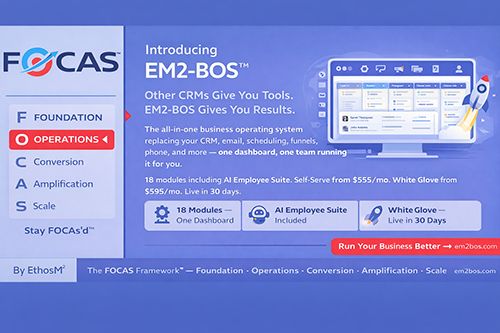
Getting Started — Setting up the System Right From the Start
Before anyone on your team starts using the system, you need to ensure it’s set up correctly. The Getting Started phase is when you design the CRM to fit your needs — creating pipelines that match your sales processes, setting up automations that follow your customer’s journey, and using tagging logic that reflects how you segment your audience. This isn’t a one-size-fits-all solution. It’s a customized design built to match your specific operational needs.
It is important to establish a solid foundation because every subsequent adoption problem becomes more difficult to solve if the basic structure is not correct. A pipeline that does not accurately represent your team’s sales process will always seem unfamiliar to the people using it. If the system is designed around actual workflows from the beginning, resistance to adoption decreases significantly before ASE OGUN is even considered.
Operations — Where AI Support Intelligence Makes Adoption a Reality
This is the phase where most agencies abandon their clients — and where AI support intelligence really shines. The Operations phase is where the system meets the people who have to use it every day, and that intersection is where adoption either thrives or fails. AI support intelligence comes into play here, providing the continuous intelligence layer that turns a correctly built system into a confidently used one. Every question answered, every process explained, every team member guided through a new feature — this is Operations in action, and it’s what makes the difference between a system that’s live and a system that’s actually working.
Conversion — What Happens When Your Team Actually Trusts the System
When team members trust the CRM — when they know how to use it, when they get answers quickly, when the system reflects their actual work — something shifts. They stop avoiding features and start leveraging them. Follow-up sequences run on time. Lead status gets updated accurately. Pipeline reports actually reflect reality. That operational confidence flows directly into conversion outcomes: more leads nurtured correctly, more deals moving through the pipeline, more clients retained through consistent communication.
The link between CRM adoption and revenue conversion is concrete. Each correctly implemented automation, each timely follow-up, each correctly segmented lead sequence represents a real revenue opportunity that would have been missed when the system was being quietly ignored. For more insights, explore this Harvard Business School publication on the impact of technology implementation on business outcomes.
Growth — Expanding Systems as Skills Expand
When your team truly understands the system, a potent possibility arises: the work begins to multiply. Automations operate without the need for manual input. Reporting brings to light insights without someone having to search for them. The introduction of new clients is system-driven, not reliant on the extraordinary effort of an individual. The Growth phase is when the return on your technology investment begins to accumulate — but it only gets to this stage if the Operations phase has been carried out properly.
ASE OGUN’s role in Amplification is to make sure that as the system becomes more advanced, the team’s skills also improve. More advanced automation logic, more nuanced segmentation, more complex pipeline configurations — ASE OGUN supports all of this, so the system’s growing capability never surpasses the team’s ability to work within it.
Scaling – Growth Driven by Infrastructure, Not by Superhuman Effort
In the FOCAS Framework, scale has a very specific meaning: your business grows because the infrastructure takes the weight, not because key people are putting in more effort. This is what separates a business that scales from a business that just gets busier. When the CRM is fully integrated, the automations are working as they should, and the team is skilled across all operational workflows, growth doesn’t lead to disorder – it leads to exponential returns.
Many small businesses don’t get to this point with their technology investments because they were never able to get past the Operations phase. They built the infrastructure, didn’t manage to encourage adoption, and ended up tearing down the system out of frustration. The FOCAS Framework is intended to systematically close that gap, with ASE OGUN acting as the engine that propels Operations forward at every growth stage.
The Common Oversight in Many Agencies: Ending at the Basics
Most agencies create your CRM, give you the controls, and depart. They’ve accomplished the basic phase — and from their viewpoint, the job is complete. What they’ve actually done is create a complex piece of technology and left before the people who have to utilize it daily were ever truly supported. EM2-BOS is based on a different principle: that the technology is only as useful as the team’s ability to work within it, which means the work doesn’t stop at launch. It starts there.
Practical Consequences: A Comparison
- An employee hits a roadblock with a basic CRM task and can’t proceed without assistance
- The business owner is forced into a support role, distracting them from their growth role
- A follow-up sequence is not triggered because a contact was incorrectly tagged
- A promising lead goes cold during the two-day delay while the question remains unresolved
- The deal falls through — not because the offer was unsuitable, but because the system was not properly utilized
This series of events occurs in small businesses on a weekly basis. It doesn’t show up on any report. There’s no “deal lost due to CRM non-adoption” line in the analytics dashboard. It just silently siphons off revenue while the technology investment remains underused. The true cost of marketing automation failure is not the subscription fee — it’s the compounding revenue that never comes to fruition because the system never really activated.
When ASE OGUN is integrated into the infrastructure, it’s not just the speed of support that changes. The whole operational culture surrounding the technology changes. Questions are answered. Confidence is built. The system begins to feel like a resource rather than a hindrance. And this shift – from avoidance to proficiency – is what changes the financial return on the technology investment.
This isn’t just a theoretical comparison. It’s the recurring difference between companies that introduce technology and companies that introduce technology with a built-in intelligence layer. The former results in shelf-ware. The latter results in what EM2-BOS refers to as living infrastructure — systems that don’t merely exist but actively serve as daily operational power within the business.
The financial impacts are clear and quantifiable. A quicker learning curve means less time spent in the adoption process. Greater system use means more automation operating properly. Less owner involvement means management time is redirected towards expansion rather than support. Improved tech investment returns means the $10,000 you invested starts growing instead of sitting idle. These aren’t vague advantages — they’re the practical results that occur when the adoption gaps are truly filled.
Before ASE OGUN: The Scenario of Delays, Frustrations, and Lost Deals
Imagine it’s Tuesday at 2pm. Marcus, your sales coordinator, is trying to push a warm prospect through the sales funnel. He needs to initiate a proposal sequence but he’s not sure which stage in the sales funnel triggers it — and he doesn’t want to risk sending a duplicate email to the prospect. So, he messages the owner. However, the owner is busy with a client call. Three hours go by. Marcus decides to focus on other tasks. The owner finally responds at 5:30pm, but Marcus has already left for the day. On Wednesday morning, Marcus sees the response, completes the task — but the prospect, who was ready and engaged on Tuesday afternoon, has already talked to a competitor. The deal falls through. No one links it to the delay in CRM support. The revenue just vanishes.
Getting Immediate Answers and Taking Confident Actions with ASE OGUN to Move Deals Forward
Imagine the same scenario on the same Tuesday afternoon. Marcus is unsure about which pipeline stage will trigger the proposal sequence. He asks ASE OGUN directly within the platform. In less than 30 seconds, he receives a specific and accurate answer that references his exact pipeline configuration: move the contact to the Proposal Ready stage, confirm the email address is verified, and the sequence will automatically fire within the hour. Marcus makes the move. The sequence fires. The prospect receives the proposal before they’ve had time to consider alternatives. The deal moves forward. The revenue is captured.
In this case, the disparity wasn’t due to intellect, hard work, or sales expertise. It was a matter of operational infrastructure. Marcus knew what to do as soon as he had the solution. The solution was available in 30 seconds instead of 18 hours. This gap, measured in hours, dictated the revenue result. When you multiply this across your entire team and every week of the year, the cumulative effect of quick CRM adoption support becomes too significant to overlook.
Four Ways Adoption Gains Build on Each Other
When team members are able to reach operational proficiency in weeks rather than months, revenue drag is reduced with each new hire. When the business owner’s time is spent driving strategy and growth instead of answering CRM questions, the owner bottleneck is reduced. When more automations are running correctly, more data is captured accurately, and more insights are available for decision-making, system utilization is higher. When the platform cost becomes a clear line item with a measurable return instead of an ambiguous expense that’s hard to justify at budget review time, the technology investment ROI is better. These four compounding effects don’t operate independently. Each one accelerates the others, and together they represent the difference between a CRM implementation that transforms a business and one that simply adds another subscription to the monthly overhead.
The Impact on Small Businesses
Small businesses face a unique set of challenges when it comes to CRM adoption, challenges that Fortune 500 companies simply don’t have to worry about. It’s not that these large corporations have more tech-savvy teams, it’s that they have entire departments dedicated to ensuring the success of their CRM systems. These organizations employ CRM administrators whose sole responsibility is to maintain the system, train new users, build new workflows, and troubleshoot any problems that arise. They have IT departments, internal training teams, dedicated vendor success managers, and change management specialists who help guide the company through any technological transitions. Small businesses, on the other hand, typically don’t have these resources. Instead, they have a business owner, a small team, and a URL for a help center. This disparity in support is vast and it’s a key reason why CRM adoption failure is so prevalent in the small business and nonprofit sectors.
Big Businesses Have IT Departments. You Have ASE OGUN.
If a sales representative at a large corporation doesn’t understand how to use a feature in their CRM, they can simply submit a request to their in-house IT help desk. They’ll receive a response within the hour. There’s a dedicated administrator who knows the system like the back of their hand, a training team that provides quarterly refresher courses, and a vendor success manager who is always available at the touch of a button. This kind of support is something that most small business owners have never experienced because they’ve never had access to it. But they feel its absence every day — in the questions that go unanswered, the features that go unused, and the technology investments that fail to deliver the returns they promised.
ASE OGUN is here to bridge the gap. It acts as the CRM manager, the training unit, and the around-the-clock support expert — all of these roles are integrated into the infrastructure, and they function at the pace that your team does. This isn’t about imitating enterprise systems for the sake of it. It’s about understanding that the support system surrounding the technology is just as important as the technology itself, and that small businesses should have access to both without requiring the headcount of an enterprise to manage them.
Equal Opportunities: High-Quality Support Without the High Costs
The term “equal opportunities” is often thrown around in small business marketing. In this case, it has a particular meaning: your team will receive the same level of in-system guidance, the same speed of support, and the same depth of operational intelligence that a mid-market company with a dedicated CRM team would have — all without the need to hire a CRM administrator, a training coordinator, or a change management consultant. The operational capability that used to require a $200,000 support infrastructure is now built into the platform your business runs on.
For small businesses, this is not a small advantage, especially when they are competing against larger, more resourceful competitors. When your team is as fluent and confident in your CRM as a company three times your size, the gap in operational output narrows significantly. You’re not outspending them. You’re outsmarting them, which is a more sustainable competitive position than a budget will ever be.
How This Ties to the EM2 Mission for SMB Growth
At Ethos Media Marketing & Consulting (EM2-BOS), we are driven by a single belief: that the marketing technology and operational infrastructure once available only to large brands should be fully accessible to small businesses, nonprofits, and professional service providers. ASE OGUN isn’t a product feature added to meet a market trend. It’s a direct expression of that mission — the recognition that handing a small business powerful software without the intelligence layer to activate it isn’t democratizing technology. It’s just selling it.
The Unseen Edge
The most potent competitive edges are those that your rivals can’t easily spot or duplicate. A superior price can be met. A more dazzling brand can be duplicated. A novel service offering can be copied within three months. But the operational proficiency of your team — their adeptness within your systems, their pace of execution, their capacity to operate intricate automations without bottlenecks — that’s more difficult to discern from the outside and much more challenging to duplicate rapidly. It’s also the edge that accumulates the longest.
When your team is truly utilizing your CRM, the benefits build upon each other in a way that reinforces itself over time. Here’s what’s really going on behind the scenes when adoption is successful:
- All leads are accurately captured, tagged, and routed, ensuring no revenue is lost due to system errors.
- Automations function as intended, providing consistent customer experiences without the need for manual input.
- Pipeline data is accurate, enabling reliable forecasting and decision-making.
- New team members can get up to speed quickly because the intelligence layer supports their learning from their first day.
- The owner can focus on growing the business rather than troubleshooting because the system takes care of what it’s supposed to.
You won’t find any of this in a product brochure or a feature comparison chart. It’s the unseen infrastructure that distinguishes businesses that operate on systems from those that operate on effort. And it’s exactly what ASE OGUN is designed to do.
Your Rivals Buy Software. You Get Intelligence Built Into the System.
When your rivals implement a CRM, they go through the standard cycle: purchase, onboard, train once, and watch adoption quietly erode over the following 90 days. They end up with a technically configured system and a team that’s learned just enough to get by. When you implement through EM2-BOS, you get the same powerful platform infrastructure — plus ASE OGUN operating as the intelligence layer that activates and sustains real adoption across your entire team. The software is the same category of tool. What’s different is whether the tool actually works in the hands of the people using it every day.
What Separates a $10K Expense from a $10K Investment That Grows
Technology spending without adoption is an expense. It drains resources, delivers minimal return, and loses value as the gap between what the system can do and what the team actually does grows wider. Technology spending with genuine adoption is an investment — one that grows as team competency increases, as automations mature, as pipeline data becomes richer, and as the operational intelligence embedded in the system reveals new opportunities for growth. That’s the difference between a $10,000 expense that collects dust and a $10,000 investment that grows indefinitely. The technology is almost identical in both scenarios. The intelligence layer around it is not.
ASE OGUN as a Secret Weapon in a Competitive Market
Let’s call a spade a spade: it’s a secret weapon. Not because it cheats or takes shortcuts, but because it provides your team with a level of support, speed, and operational certainty that your competitors simply don’t have through standard CRM implementations. While they’re waiting for two days for a support ticket response to a basic pipeline question, your team has the answer in half a minute and the deal is already moving forward. That imbalance — repeated across hundreds of small interactions every month — creates a compounding operational gap that’s very hard to close from the outside. Learn more about the hidden costs of CRM integrations and how they can impact your business operations.
It’s not always the businesses with the best product or the largest marketing budget that come out on top in competitive markets. Rather, it’s the businesses whose internal operations are efficient, quick, and reliable enough to convert every opportunity into a positive result. CRM adoption is the unglamorous, unseen force behind this type of performance, and ASE OGUN is what keeps this force in motion without necessitating that your entire leadership team become technology administrators.
Here’s what overcoming the Authority Ceiling looks like in real life. It’s not a new marketing campaign. It’s not a rebrand. It’s not a new offer. It’s a team that operates with the fluency and confidence of an organization twice its size, supported by living infrastructure that was built — and continuously activated — with that outcome in mind. That’s when businesses become systems. And that’s exactly what EM2-BOS is designed to create.
Conclusion & Call to Action
There’s a CRM adoption crisis, and it’s not because of technology, budget, or team competency. It’s an infrastructure issue — specifically, a lack of an intelligence layer that bridges the gap between a well-built system and the people who use it daily. This gap is where technology investments worth thousands of dollars vanish. It’s where potential leads go cold, automations fail without a sound, and well-meaning teams revert to the spreadsheets they know. Closing this gap isn’t complicated in theory. It involves building intelligence into the infrastructure from the start, not adding support as an afterthought once adoption has already failed.
ASE OGUN was designed to bridge this gap – not as a helpdesk workaround, not as a chatbot that answers generic questions, but as the activating intelligence that turns marketing technology into operational power. When the FOCAS Framework is executed correctly, with ASE OGUN operating through the Operations phase and beyond, the result isn’t just a functioning CRM. It’s a team that trusts their systems, leadership that has time to lead, and a technology investment that generates compounding returns instead of compounding frustration.
ROI is Determined by Adoption — Not the Software You Purchased
The platform is less important than you might believe. GoHighLevel, HubSpot, Salesforce — these are all potent tools when wielded by teams who know how to use them. The determining factor in your technology ROI isn’t the platform you selected. It’s the extent of adoption your team can achieve within it. Adoption is the multiplier that makes everything else function — and it’s the factor that most agencies, vendors, and implementation consultants completely leave up to luck.
How to Identify a Good Infrastructure Partner
Before you sign another contract with a marketing agency or technology consultant, ask these questions — because the answers will tell you whether you’re about to build living infrastructure or buy more shelf-ware:
- What happens after you launch? How does the company support adoption beyond the initial onboarding?
- What does ongoing team support look like — and how fast is it?
- Is there a system in place for new hires to get up to speed without relying on the owner?
- How does the implementation adapt as the team’s competency grows?
- What’s the plan when a team member doesn’t know how to use a feature and needs an answer right now?
If the answers are vague — a help center link, a support email, a promise that the documentation is comprehensive — you already know what the next 90 days look like. The right infrastructure partner doesn’t hand you keys and walk away. They build the intelligence into the system that keeps your team moving forward long after the kickoff call is a distant memory. For more insights, explore why your CRM feels like another tool you’re paying for but not using.
We don’t just hand you software and leave. That’s not a slogan at EM2-BOS — it’s the foundational promise that sets every engagement apart from the standard build-and-bail model that the industry has come to expect. The FOCAS Framework ensures that the Foundation is right, Operations are running, and the intelligence layer that makes both possible is built in from the start. That’s what it means to build where businesses become systems.
Schedule Your Discovery Strategy Session With Ethos Media Marketing & Consulting
Are you eager to experience the real impact of successful CRM adoption? Do you want to know where your business stands on the FOCAS Framework? Then, schedule a Discovery Strategy Session with Ethos Media Marketing & Consulting. Be prepared to discuss the technology investments that didn’t work out for your business. In return, you’ll gain a vivid understanding of what living infrastructure means for your unique operation.
Commonly Asked Questions
Here are the questions that are most frequently asked by small business owners and nonprofit leaders before they start using ASE OGUN as part of the EM2-BOS platform.
How is ASE OGUN different from your average CRM chatbot or help widget?
Your typical CRM chatbot responds to basic inquiries by pulling from a general knowledge base. It isn’t aware of your pipeline structure, your automation logic, your naming conventions, or your unique workflow configurations. It provides the same response it provides to every other user on the platform — which may or may not be relevant to your circumstances.
ASE OGUN is customized to your unique EM2-BOS setup. When a team member has a question, the answer is tailored to their actual system — their pipeline stages, their automation sequences, their segmentation logic. This contextual specificity is what separates ASE OGUN as an intelligence engine from a help widget, and it’s what makes the advice practically useful rather than just informational.
Is ASE OGUN Suitable for Small Businesses Without Technical Expertise?
Absolutely — that’s exactly who it was created for. ASE OGUN is designed to engage users at their current level of technical comprehension and help them progress from there. You don’t need a technical background to ask a question and get a clear, actionable response. The intelligence layer takes care of the technical complexity so your team can concentrate on getting the job done, not on figuring out platform architecture.
What Role Does ASE OGUN Play in a GoHighLevel CRM Configuration?
ASE OGUN functions as the support intelligence component within the EM2-BOS GoHighLevel framework. GoHighLevel is the platform infrastructure — the pipelines, the automations, the CRM database, the communication tools. ASE OGUN is the intelligence that brings that infrastructure to life by ensuring your team knows how to use it correctly, consistently, and with confidence. Picture GoHighLevel as the engine and ASE OGUN as the operational knowledge that ensures everyone in the vehicle knows how to operate it.
How Long Before We Start Seeing the Benefits of ASE OGUN?
Most teams start to see a noticeable improvement in the speed of resolving queries and a reduction in the reliance on the owner within the first two to four weeks of using the system. The broader benefits of using the system – more use of the system, fewer workarounds, more automations working as they should – usually start to build up over the first 60 to 90 days as team members get used to the system through regular, supported use. Unlike training models that are a one-off where the benefits quickly tail off after the training, because ASE OGUN is always available, the benefits of using the system continue to increase rather than level off.
Can ASE OGUN be used by businesses not already working with Ethos Media Marketing & Consulting?
ASE OGUN is integrated into the EM2-BOS operating environment, so it only works within the system that Ethos Media Marketing & Consulting designs and maintains for its customers. It’s not a standalone plugin that you can add to a CRM setup built by another agency, because its smart capabilities rely on being trained on the specific system it’s supporting.
Are you working with an agency or managing your own CRM that isn’t producing the adoption results you want? That’s exactly what a Discovery Strategy Session is for. The session isn’t about pressuring you to change platforms. It’s about giving you a clear idea of where your current setup is lacking and what you need to do to fix it.
Most small business owners have never experienced the level of CRM support that ASE OGUN offers, which means there’s often a significant gap between what they think is possible and what’s actually available. The session is designed to close that information gap before any commitment is made. For insights on common CRM challenges, you can read about small business CRM failures.
By now, you understand that the issue isn’t with the technology. You recognize that the problem lies in the adoption phase, and you realize that most of the proposed solutions — onboarding calls, documentation libraries, support tickets — were never actually designed to address that problem at the speed and scale your business requires. But now you know what can. Your next move is up to you. Ethos Media Marketing & Consulting creates the living infrastructure that transforms your technology investment into operational power — and ASE OGUN is the intelligence that keeps it running.
Many small businesses struggle with implementing new technology effectively, often leading to failure. This is particularly true for CRM systems, which can feel like just another tool that businesses are paying for but not using. Understanding the real reason your CRM feels underutilized can help businesses overcome these challenges and make better use of their technology investments.


 By
By

 By
By