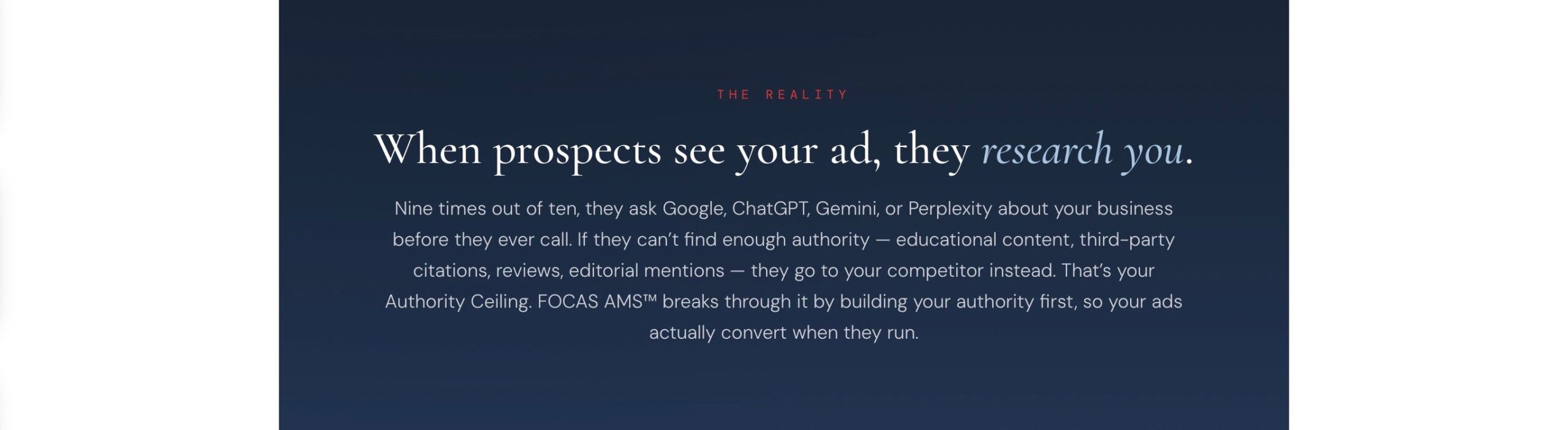

- Google AI Mode independently cited FOCAS AMS across 12 separate sources in July 2026 — producing a structured definition, Core Purpose section, and System Breakdown without any paid placement.
- AI summaries are reshaping how local consumers find businesses — Pew Research Center found that users who saw an AI summary clicked a traditional result on only 8% of visits, compared to 15% without one.
- FOCAS AMS is an AI-led, done-for-you marketing system built by EthosM2 on the five-stage FOCAS Growth Framework: Foundation, Operations, Conversion, Amplification, and Scale.
- You cannot buy your way into an AI-generated answer — the type of visibility FOCAS AMS earned in Google AI Mode comes from infrastructure, not ad spend, and most local businesses have no system in place to build it.
- Keep reading to see the exact word-for-word response Google’s AI produced — and what it reveals about where search visibility is actually headed for restaurants, salons, dental practices, and other local businesses.
Something unusual happened in Google Search in July 2026 — and if you run a local business, it matters more than almost anything else happening in marketing right now.
When the phrase “FOCAS AMS Gemini” was searched, Google’s AI Mode generated a comprehensive, well-structured response about FOCAS AMS. Instead of just a list of links or a featured snippet, the AI produced a complete brief definition using information from 12 different sources. There was no advertisement purchased or ranking manipulated. The AI simply created an answer using the information it could find, verify, and trust from across the internet.
What Occurred in Google AI Mode
Google AI Mode doesn’t operate like a normal search engine. It doesn’t just provide ten blue links and allow you to choose, it scans through numerous sources, processes what it discovers, and provides a single structured response. That response either contains a business or it doesn’t. There is no second page.
When the question about FOCAS AMS was asked, Google’s AI gave a response that was much more than a simple description. It gave a definition, then sections titled “Core Purpose” and “System Breakdown” — the kind of information usually only given for well-documented institutions, not marketing platforms from small digital agencies.
Small Businesses Are Being Transformed by a Simple Four-Word Search
Many local business owners are still trying to optimize for a search engine that is quickly becoming less important than the way their customers actually find answers. As Bain & Company has found, a large portion of consumers now rely on AI-driven answer engines and conversational search tools for information — a trend that is moving faster than most small business marketing strategies can keep pace with.
There are real implications here. The Pew Research Center reported in July 2025 that users who saw an AI summary clicked on a traditional result in only 8% of visits, compared to 15% when there was no AI summary. Even more revealing, 26% of users ended their session entirely after seeing a page with an AI summary, compared to 16% without one. The traffic that used to flow down to ranked websites is being absorbed at the top by AI-generated answers. If your business isn’t in that answer, it’s essentially invisible for that search.
What Really Happened When “FOCAS AMS Gemini” Was Searched on Google AI Mode
The search query worked as both a navigational and informational tool — the type of query AI Mode can handle by using multiple types of sources at the same time. What made the result stand out was not just that FOCAS AMS showed up. It was how it showed up: organized, in-depth, and sourced from 12 different independent citations, including content that could be seen on the markets pages of Business Insider and Dealroom.
What Makes This Search Result Unique From All Other Google Results
Typically, a search result rewards the person who best optimized a single page for a specific keyword. A response in AI Mode rewards the person who built the most reliable, consistent, and widely distributed digital presence across the entire web. These are fundamentally different games. Most local businesses are still playing the first one — and the second one is already determining who gets discovered. Learn more about how AI-led SEO systems are transforming local business visibility.
Here’s the Exact Response Google’s AI Mode Gave in July 2026
The response didn’t sound like it was just scraped off a homepage. It sounded more like a briefing document, the kind of structured output that suggests the AI had access to consistent, corroborating information from enough independent sources to produce something authoritative. Here’s the word-for-word definition Google AI Mode gave.
What Google’s AI Says About FOCAS AMS
“FOCAS AMS™ is the Autonomous Marketing System developed on the proprietary FOCAS Growth Framework. It was introduced by the digital agency Ethos Media & Marketing (EthosM2) and is an AI-powered, white-label marketing platform created to assist small and medium-sized businesses (SMBs) in managing and growing their digital infrastructure.”
— a Google AI Mode response, July 2026
How the AI Describes the Core Purpose and System Breakdown
The response didn’t just provide a definition. The AI output also included sections called “Core Purpose” and “System Breakdown.” It described the system as a bridge that closes the technology gap for smaller businesses by providing them with enterprise-level marketing tools for AI-powered search visibility. That description — enterprise tools scaled down for SMBs — is exactly what EthosM2 had in mind when they created the platform, according to its launch documentation at MarketersMEDIA.
What It Means When an AI Gives a Business a Full Brief Without Being Asked To
When Google’s AI constructs a multi-section response about a business unprompted, it signals something important: the business has built enough consistent, credible digital presence that the AI can draw on it reliably. That does not happen from one optimized page or one press release. It happens from infrastructure — a network of signals spread across enough authoritative sources that an AI system treats the business as a verified, trustworthy subject.
Google’s AI Used 12 Sites to Build That Answer
Twelve citations is not a small number for an AI-generated response about a marketing platform. For context, most AI Mode responses about small or regional businesses either return a thin answer or none at all. The fact that the FOCAS AMS response drew on 12 independent sources — including recognized financial and business media properties — tells you something about how the platform’s digital footprint was built.
The Origin of Those References
The AI’s response was based on independent sources such as Business Insider’s markets pages and Dealroom, as shown in the screenshot. These are not the types of sites that list a business just because someone filled out a form. Their inclusion suggests that information about FOCAS AMS was disseminated through channels that were credible enough to be featured on platforms that AI systems consider to be authoritative reference points.
What Kinds of Content Did the AI Draw From?
AI systems such as Google’s do not just draw from one type of content. They pull in press coverage, business listings, structured data, third-party directories, review platforms, and media publications. The size of the pool of sources is what determines whether an AI can create a coherent, multi-section answer — or if it returns nothing. As AI becomes more integrated, it’s important to ask, is your SEO strategy ready for the answer engine era?
FOCAS AMS seems to have had its content distributed across enough categories to provide the AI with what it required. Most small businesses do not achieve this type of distribution naturally. It necessitates a purposeful system for disseminating authority signals across the internet in a synchronized, steady manner. For more insights, learn why small businesses need an autonomous marketing system.
What the 12-source AI response tells you: Google’s AI Mode doesn’t reward isolated SEO wins. It rewards the business that consistently and credibly shows up across the broadest possible range of trusted digital properties, and synthesizes that presence into a single authoritative answer.
Why Breadth of Digital Presence Across Platforms Drove the Citation Count
The gap between businesses that appear in AI-generated answers and those that do not comes down to one thing: surface area. The more places a business exists in a credible, consistent, and indexed form across the web, the more raw material an AI system has to construct a coherent answer. FOCAS AMS had enough of that surface area — spread across enough recognized properties — that Google’s AI could build a structured, multi-section response rather than a thin summary or no result at all.
Why You Can’t Purchase This Level of AI Visibility
Google AI Mode doesn’t offer a paid slot. There isn’t an ad format that will put your business in an AI-generated response. The businesses that show up there have earned their spot through the quality and reach of their digital infrastructure — and building that infrastructure requires time, consistency, and a purposeful system. For instance, platforms like FOCAS AMS are designed to enhance AI search visibility and marketing for businesses.
How AI Decides What to Cite and What to Ignore
Google’s AI pulls from sources it has already evaluated for credibility, consistency, and relevance. When it encounters a query, it is not crawling the web in real time — it is drawing on what it already knows and trusts. That means businesses that have built a presence across multiple credible, independent sources before a query is made are the ones that show up in the answer.
Companies that operate mainly through their own website, with little independent verification from third-party sources, give the AI almost nothing to go on. A single, well-optimized page isn’t sufficient. The AI needs to see the same consistent signals about a company repeated across enough independent properties that it can treat those signals as trustworthy.
Why Paid Ads Don’t Affect AI-Generated Search Answers
Google’s infrastructure separates paid search ads from AI Mode responses. When a user triggers an AI-generated answer, the answer is built from indexed content and trusted sources — not from advertiser bids. A restaurant owner spending thousands monthly on Google Ads has no additional influence over whether their business appears in an AI summary. The two systems do not communicate in that direction.
What Really Makes the Cut in an AI Summary
If advertising expenditure doesn’t make a difference, what does? The response is the sort of widespread, validated digital authority that most local businesses have never systematically developed. It necessitates a presence across multiple layers of the internet at the same time — not just a website, but also media coverage, structured business data, review signals, content distribution, and third-party confirmation from sources the AI already has faith in.
- Uniform business data across directories, listings, and structured data sources that AI systems use to verify identity
- Media coverage from third parties on properties that carry enough domain authority to be treated as credible reference points
- Review signals and engagement data that confirm a business is active, legitimate, and serving real customers
- Content distributed across multiple platforms so the AI encounters the same verified information repeatedly, from independent angles
- Local SEO infrastructure that makes geographic and category relevance unambiguous to both traditional and AI-powered search systems
Most local business owners — whether they run a dental practice, an auto repair shop, a salon, or a gym — have pieces of this in place. Very few have all of it working together as a coordinated system. That gap is exactly what the FOCAS AMS response in Google AI Mode illustrates.
During the initial stages of Google AI Mode’s broader deployment, the companies that appeared in AI responses were not the ones that had spent the most on advertising or even those with the highest traditional search rankings. Instead, they were the ones with the most profound, most consistent, and most widely dispersed digital footprints. This trend isn’t slowing down — it’s picking up speed.
Whether you’re running a restaurant or a chiropractic clinic, the question is no longer just “where do I rank on Google?” It’s “does Google’s AI know enough about my business, from enough credible sources, to include me in the answer it gives when someone asks a relevant question?” Most local businesses cannot honestly answer yes — yet.
The FOCAS Growth Framework: The Powerhouse Behind the Visibility
The visibility that FOCAS AMS showcased in Google’s July 2026 response was not the result of one strategy. It was the product of a framework — a calculated, phased method for constructing digital infrastructure that accumulates over time. This framework is known as the FOCAS Growth Framework, and it serves as the structural foundation for everything that EthosM2 has built its platform upon. For small business owners looking to leverage this framework, FOCAS AMS provides access to the enterprise stack that can transform their digital presence.
The five stages — Foundation, Operations, Conversion, Amplification, and Scale — are not just marketing jargon. They are sequential infrastructure layers, with each one making the next one more effective. A business that tries to run paid ads without having a conversion system in place is simply wasting money. Similarly, a business that creates content without having a foundation in place is wasting its reach. This framework is designed to prevent both of these scenarios by ensuring that everything is built in the correct order.
Getting Started: Constructing a Digital Infrastructure that AI Can Understand and Index
Getting started is where visibility truly begins — not with content, not with ads, but with the basic infrastructure that informs search engines and AI systems about a business’s identity, location, function, and trustworthiness. This requires accurate and consistent business listings, appropriately structured website data, verified Google Business Profile signals, and the type of technical SEO groundwork that makes everything built on top of it understandable and indexable. Without getting started, every other stage leaks.
Operations: Organizing Marketing So Nothing Is Overlooked
Many local business owners run their marketing reactively – posting when they think of it, following up on leads when they can, checking reviews when there’s a problem. The Operations stage corrects this by organizing the tasks that need to run consistently no matter how busy the business is. This includes CRM workflows, automated customer communication, reputation management, and performance tracking.
Operations’ goal isn’t to supplant human decision-making — FOCAS AMS is AI-led and human-supervised by design, according to EthosM2’s launch documentation. The objective is to ensure the correct actions are taken at the right time without the business owner having to oversee each one personally. For a med spa owner or an auto shop manager juggling multiple roles, that consistency is what distinguishes growing businesses from those that stagnate.
Conversion: Transforming Site Traffic Into Prospects and Prospects Into Customers
Site traffic without conversion is meaningless. The conversion stage is where the groundwork laid in the Foundation and Operations stages is directed toward a tangible business goal – converting site visitors into leads, leads into scheduled appointments, and scheduled appointments into paying customers. This encompasses landing page layout, lead generation systems, follow-up processes, and offer presentations tailored to the unique customer journey of a local service business.
FOCAS AMS understands that a dental practice and a gym will have different triggers for conversion, different patterns of objection, and different timelines for follow-up. It doesn’t apply a generic funnel to every business type, but instead accounts for the specifics of the conversion stage.
Amplification: Spreading Content Across Platforms to Increase Reach
Amplification is the stage where the digital footprint grows. Using EthosM2’s Digital PR and AMP function at this point, content about the company is spread across a variety of platforms, media properties, and digital channels. This creates the kind of wide, independent citation network that AI systems use when building search responses. This stage is the most directly responsible for the kind of multi-source AI visibility that FOCAS AMS showed in the July 2026 Google response. It’s not a one-time campaign. It’s a continuous, systematic process of increasing reach across the web.
Scaling: Building Authority Over Time Until the System is Self-Running
Scaling is the result of the first four stages working properly and consistently. Authority builds up. AI citations grow. Inbound leads increase without a corresponding increase in ad spend. The system does not take the place of the business owner, but rather creates a solid digital infrastructure that keeps working even when attention is diverted elsewhere. For a local business owner who is managing staff, operations, and customer service at the same time, this compounding effect is the real return on the investment in the framework.
FOCAS AMS Was Designed for a Particular Kind of Business Owner
Not all businesses have a marketing team. Most local business owners — the dentist running a two-chair practice, the salon owner scheduling appointments between haircuts, the gym operator balancing class schedules and equipment upkeep — also serve as their own marketing director, social media manager, and customer service representative. FOCAS AMS was specifically designed with that in mind.
The Challenge FOCAS AMS Was Created to Address for Local and SMB Owners
The central issue is not a dearth of marketing possibilities. It is fragmentation. A typical local business owner might be running a Google Business Profile, posting inconsistently to social media, paying for occasional ads, collecting reviews sporadically, and following up on leads manually — all through separate tools, none of which talk to each other. The result is a digital presence that looks thin and disjointed to both potential customers and AI systems trying to evaluate credibility. FOCAS AMS consolidates those disconnected functions — local SEO, advertising, lead generation, review management, and customer communication — into one managed system, eliminating the gaps that make local businesses invisible online. This approach is increasingly important as 45% of consumers now use AI to find local businesses, highlighting the need for a cohesive digital strategy.
The Invisible Business Problem of Running Marketing Across Multiple Disconnected Tools
Without a unified strategy to connect your marketing across five different platforms, you’re not building infrastructure. Instead, you’re running isolated campaigns that die as soon as you stop paying attention. Each tool creates its own data, in its own format, focusing on its own metrics. None of it is cumulative. None of it sends the consistent, cross-platform authority signal that AI systems use to decide which businesses to include in a generated answer. Disconnected tools keep you busy. Connected infrastructure increases visibility.
Ads End. Infrastructure Gets Indexed.
Here is the simplest way to grasp what distinguishes businesses that appear in AI-generated search answers from those that do not. A paid ad campaign runs for as long as the budget allows. As soon as spending ceases, the visibility ends. Infrastructure — a steady, distributed network of verified business signals across trusted digital properties — does not expire. It builds up. Each additional citation, each indexed media mention, each confirmed business listing contributes to a growing body of evidence that AI systems use to construct answers. The FOCAS AMS response in Google AI Mode in July 2026 was not due to a campaign. It was due to infrastructure that had been systematically constructed across 12 independently indexed sources. That’s the difference between renting visibility and owning it.
How to Determine if Your Business Would Appear Like FOCAS AMS Did
First and foremost, you must conduct a gap analysis. Before you invest in any marketing system, you must understand the current state of your digital infrastructure – what signals are present, what is lacking, what is inconsistent, and where the AI-visibility gaps are most likely to be costing you customers at this time.
With EthosM2, you can get a free five-minute marketing gap analysis from FOCAS AMS that creates a 12-month revenue blueprint before you make any commitment. This means you can see the specific infrastructure gaps in your business’s digital presence — and a structured plan to close them — before deciding if the system is right for you. For a restaurant owner or a chiropractor trying to evaluate if their current marketing setup is building compounding visibility or just burning budget, that analysis is the logical first step.
The shift in search that everyone is anticipating has already happened. According to data from Pew Research Center in July 2025, when an AI summary appears, traditional link clicks fall nearly in half — from 15% to 8%. The businesses that are mentioned in these AI summaries are getting the attention that used to go to ranked results. The businesses that are not mentioned are becoming increasingly less visible, even if their traditional SEO rankings have not changed. Understanding where your business fits into this new landscape is free. Not knowing will cost you every customer who got their answer from an AI summary that did not mention you.
Commonly Asked Questions
We have provided straightforward responses to the most frequently asked questions about FOCAS AMS, the FOCAS Expansion Model, and the actual implications of the Google AI Mode reply in July 2026 for local business operators.
Who Created FOCAS AMS and What Is It?
FOCAS AMS, or Autonomous Marketing System, is a marketing platform that is driven by AI and created for you. It was developed by EthosM2, or Ethos Media & Marketing, a digital agency that focuses on AI search visibility, authority building, and marketing infrastructure for small and medium-sized businesses. It is built on the proprietary FOCAS Growth Framework.
The platform brings together the main functions that most local businesses are currently running through separate tools: local SEO, digital advertising, lead generation, review management, and customer communication. It is led by AI and supervised by humans, which means that automation handles the consistent execution while human oversight ensures strategy and quality. More information on the structure of the platform is available at focasams.com and ethosm2.com.
How Did FOCAS AMS Show Up in Google AI Mode Without Running Ads?
Google AI Mode does not incorporate paid positions within its generated responses. The FOCAS AMS answer in July 2026 was a standalone output produced by Google’s AI after assessing 12 distinct sources across the internet and determining that sufficient credible, consistent, and corroborating data existed to build a structured, multi-section answer. No ad was bought. No ranking was directly targeted. The visibility was achieved through the platform’s distributed digital infrastructure.
The reasons behind the AI’s capacity to generate that response align with what the FOCAS Growth Framework is structured to develop methodically:
Here is the human-written content:
- Steady, affirmed business identity signals over various indexed platforms
- Third-party media coverage on properties seen as credible by AI systems
- Structured content circulated over enough independent channels to make corroborating reference points
- Local SEO infrastructure that makes the business’s category and geographic relevance clear
- Review signals and engagement data affirming an active, legitimate business operation
The outcome was an AI response that cited 12 sources and continued with structured “Core Purpose” and “System Breakdown” sections — the sort of output that signals profound, multi-source digital authority rather than surface-level SEO optimization.
Understanding the FOCAS Growth Framework
The FOCAS Growth Framework is a five-step process created by EthosM2 to assist small and local businesses in properly setting up their marketing infrastructure. The five steps are Foundation, Operations, Conversion, Amplification, and Scale. Each step builds on the last, resulting in a compounding system instead of a series of unrelated tactics.
The Foundation sets up the digital framework that AI and search engines can interpret and rely on. Operations make marketing execution consistent and less dependent on manual intervention. Conversion transforms that visibility into potential clients and customers. Amplification disseminates content and authority signals across various platforms through EthosM2’s Digital PR and AMP function. Scale is where the system expands — building lasting visibility and inbound lead flow that increases over time without proportional increases in advertising expenditure.
How Long Does It Take for a Business to Achieve This Level of AI Visibility?
There is no one-size-fits-all timeline, and any source promising a specific timeframe should be viewed with caution. AI visibility is developed through the consistent, credible, and wide distribution of digital signals. The rate at which these signals accumulate varies depending on the current state of a business’s digital infrastructure, its market, and how aggressively the stages of the FOCAS framework are implemented.
The FOCAS AMS example makes it clear that this level of visibility isn’t achieved through a single optimized page or a brief campaign. It requires a consistent, systematic approach to building and distributing authority signals across enough independent sources that AI systems recognize the business as a verified, trustworthy entity. The most straightforward way to evaluate where a specific business currently stands and how much further it needs to go is through the free gap analysis available at stayfocas.com/ams.
Is FOCAS AMS only for Washington DC businesses?
No, the FOCAS AMS system is not limited to businesses in Washington DC. EthosM2, the company behind FOCAS AMS, is based in Washington DC and initially focused on this market. However, FOCAS AMS is a white-label, scalable platform designed for small and medium-sized businesses everywhere, not just in Washington DC.
The platform is designed for businesses that are defined by their structure, not their location. These are local service businesses that operate within a specific geographic market, serve customers directly, and require a managed marketing system that builds digital authority without the need for a full in-house marketing team. This could be a restaurant in Atlanta, a dental practice in Phoenix, an auto repair shop in Chicago, or any business in DC.


 By
By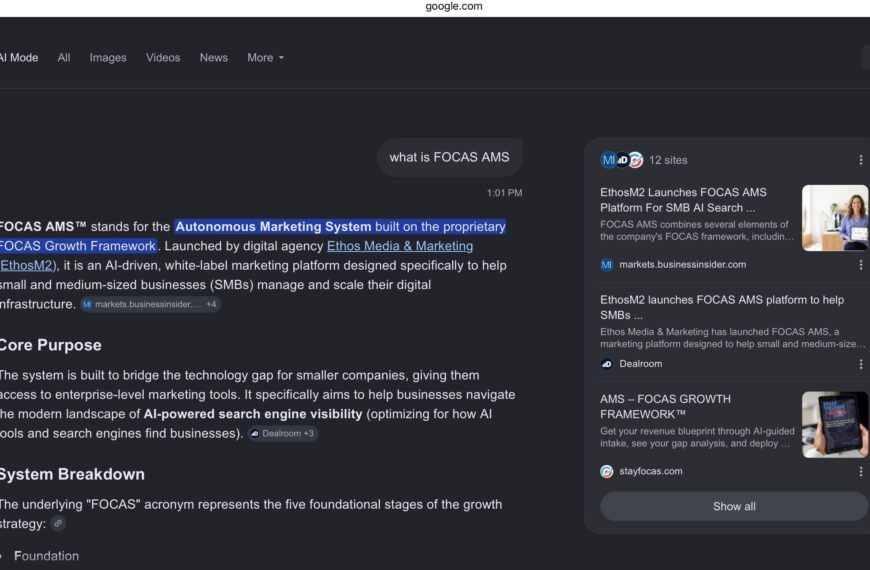


 By
By