

- AI recommendation distribution is about infrastructure, not content quality — publishing more on your own site will not close the gap between you and competitors who appear on major outlets.
- The FOCAS Growth Framework’s Amplification stage (Stage 4 of 5) is the systematic answer: one piece of expertise becomes 7+ formats distributed across 400+ premium publishers, building earned-media authority signals that search engines and AI systems use to decide who is worth recommending.
- A recent EthosM2 AI Search Audit tested 195 AI-generated answers across five environments — 153 of those answers named no tracked brand at all, meaning the authority gap is still open for businesses willing to claim it.
- Amplification multiplies whatever it is given — it rewards a business with genuine expertise worth distributing and does very little for one that does not have that foundation in place yet.
- Your AI Visibility Score measures something different from your search ranking — it tracks how often AI systems recommend you to strangers asking discovery questions, not how often people who already know your name can find you.
Most business owners are not losing to competitors with better content — they are losing to competitors with better distribution.
Why does your blog post only get 50 visits, your press release disappears into the ether, and your LinkedIn post only reaches the people who already follow you? Meanwhile, a competitor with similar expertise is featured on Yahoo Finance, appears in Google News, and is recommended by AI assistants when a potential customer asks, “Who should I work with?” The problem is rarely a lack of expertise. It’s almost always a lack of distribution. EthosM2’s Catalyst Pro was specifically designed to address this issue through the Amplification stage of the FOCAS Growth Framework.
Why Does Good Content Still Go Unseen?
Creating content is no longer the hard part. Thousands of businesses are publishing blog posts, releasing thought-leadership articles and sending press releases every single day. The problem is that most of that content lands in a closed ecosystem — it reaches an existing audience and goes no further.
The blog post, press release and LinkedIn post that almost no one sees
Consider the last piece of content your company published. Where did it end up? It likely resided on your website, was shared a couple of times on social media and possibly submitted to one press release wire. Each of those channels has a limit. Your blog is only as noticeable as your current domain authority permits. A single wire service sends a release to a list that is largely ignored by journalists. Your LinkedIn post is forgotten by the algorithm within 24 to 48 hours.
So, even though your content is expertly written and informative, it doesn’t reach the people who need it most — potential customers who are actively searching for the information you’ve provided. Consider exploring how an autonomous marketing system can enhance your content distribution strategy.
This isn’t an issue of content quality. It’s an issue of reach. And reach is a matter of infrastructure, not writing.
Why are your competitors on MSN, Google News and Yahoo Finance and you’re not?
Those competitors who appear on major platforms aren’t necessarily coming up with better ideas. What they have, whether they’ve built it intentionally or inherited it through years of PR activity, is a distribution infrastructure. Their content is reaching outlets that have domain authority, editorial credibility, and the kind of inbound link profiles that search engines and AI systems recognize as signals of genuine industry authority. Amplification is designed to build that infrastructure systematically and without relying on ad spend.
Understanding the Amplification Stage in the FOCAS Growth Framework
The FOCAS Growth Framework is a five-step process: Foundation, Operations, Conversion, Amplification, Scale. Each step is built on the previous one. Amplification is the fourth step, and it tackles an issue that the first three steps cannot address on their own — the gap between creating high-quality content and having that quality recognized at a large scale by search engines, AI platforms, and potential customers who are unfamiliar with you.
The role of Amplification in the five stages
When a company arrives at the Amplification stage, it already has a solid base, functioning systems, and conversion methods. What it doesn’t have is reach — the sort of outward, earned-media visibility that demonstrates authority to both people and machines. Amplification is the stage where the work done in earlier stages is disseminated widely enough to have a significant impact at a national or sector-wide level.
Why a good distribution infrastructure is more important than good content
Google’s guidelines are very clear about this. Their self-assessment questions for content creators ask: “Does the content provide original information, reporting, research, or analysis?” and “Does your content clearly demonstrate first-hand expertise and a depth of knowledge?” These are indicators of quality, but quality alone doesn’t distribute your content. A brilliant article on a low-authority domain is still a low-authority article in the eyes of a search engine or an AI system deciding which sources to draw from. Distribution is what gives quality its reach.
Understanding the Authority Ceiling and why it hinders numerous businesses unknowingly
The Authority Ceiling is a stage where a business may be carrying out several appropriate marketing practices — consistently publishing, maintaining a professional website, staying active on social media — yet failing to convert these activities into recognized authority and visibility. This ceiling is invisible until you examine who your AI assistant recommends when a customer asks a question you should be answering. Many business owners are unaware that they have hit the Authority Ceiling until they contrast their AI presence with that of a competitor’s. The free 18-page Break Through Your Authority Ceiling guide explains precisely how this barrier develops and what is required to move beyond it.
What Does It Mean to Be Suggested by AI?
There’s a key difference that many business owners overlook. There’s a difference between an AI system being able to locate your business when someone types your name and an AI system actively suggesting your business when a stranger inquires who they should hire, purchase from, or trust. The first is simple indexing. The second is acquired authority — and it’s the one that generates inbound demand from people who have never heard of you.
A 195-answer audit reveals a lot about unanswered questions
A recent EthosM2 AI Search Audit tested 39 real buyer questions across five AI environments: ChatGPT, Claude, Gemini, Perplexity and Google’s AI results. That produced 195 individual AI-generated answers, each evaluated for brand presence, competitive visibility and recommendation patterns. Of those 195 answers, 153 named no tracked brand at all. For more on how that gap is measured and what it means for your business, the companion article Does AI Recommend Your Business When Customers Ask Who to Choose? covers the methodology in full.
From the Amplification perspective, 153 unclaimed answers are not a negative — they are a positive. They are an open opportunity. Nobody has claimed those recommendation slots yet. This is where Distribution comes in.
Understanding what an AI Visibility Score measures — and what it doesn’t
An AI Visibility Score measures how often a business is seen when AI systems answer the questions that potential customers are asking — discovery questions from unknown individuals, not name searches from existing contacts. A business can rank on the first page of Google for its own name and still score near zero on AI visibility for the buyer questions that create new demand. These are two entirely different measurements.
How AI searching for you by name differs from AI suggesting you to someone who doesn’t know you
When a person asks an AI assistant about your business by name, the AI is simply pulling up information it already has. But when a stranger asks, “Who’s the best [service provider] for [specific need]?” the AI is making a recommendation based on a variety of factors, including how often your business is mentioned, where it’s mentioned, who’s linking to it, and how broad your presence is across reputable sources. The amplification stage is what deliberately builds up these factors.
Why Isn’t Posting More Content on Your Own Website Effective?
It’s a logical assumption. If content brings about visibility, then more content should bring about more visibility. However, Google’s own advice contradicts this theory, stating clearly that “a high number of pages doesn’t make a website higher quality or more relevant to users.” Having a lot of content on one domain doesn’t replace having a wide presence across many credible domains.
There’s a structural problem that goes beyond the issue of volume. Even the best content on a single website is limited by the authority footprint of that website. A single domain, no matter how well it’s maintained, cannot satisfy what Google calls a “query fan-out” approach. This is a technique where AI features issue multiple related searches across subtopics and data sources to come up with a comprehensive answer. To satisfy this process, you need to be present across many sources, not just deep on one. For example, 45% of customers now use AI to find local businesses, highlighting the importance of a broad online presence.
- Your website’s domain authority limits how far any single page can reach in search results
- AI systems pulling answers from multiple sources will default to the sources they already recognize as authoritative
- Publishing more pages on your own site cannot generate the external citation signals that earned media creates
- A single-domain strategy competes only within its own authority band — it cannot break out of it through volume alone
The answer is not to stop publishing on your own site. It is to ensure that your expertise also lives on the external, high-authority platforms that search engines and AI systems are already drawing from.
Google’s own guidance on volume and commodity content
Google’s guidance for content creators is clear: “Don’t just repeat what others on the internet have already said, or what could easily be generated by an AI model.” It also encourages creators to ask themselves whether their content provides “significant value compared to other pages in search results.” These are not just quality filters, they are also distribution filters. Content that merely repeats common knowledge doesn’t earn citations, doesn’t attract backlinks, and doesn’t generate the kind of earned media that can help a business break through its Authority Ceiling. Original, first-hand expertise can — but only if it gets to platforms with the authority to amplify it.
How “query fan-out” works and why it can’t be met by a single domain
Google’s AI functions use a method known as query fan-out. This means that it conducts several related searches across subtopics and data sources at the same time to create a complete response. When a user asks an AI assistant a general question like “Who are the top financial advisors for small business owners?” the system does not just use one source. Instead, it fans out across multiple sources, giving more weight to the sources it already knows are authoritative in various contexts. For a deeper understanding of how Google’s AI is impacting businesses, you can read about Google’s AI recommendations.
Even a domain that publishes a lot of content can only meet the needs of one node of the fan-out. If a business wants to be present in all subtopics and data sources that an AI system uses, it needs to be present on many external platforms at the same time, and it needs to do so credibly and with editorial weight. That’s why we need a distribution infrastructure, and that’s the main problem that Amplification is designed to solve.
How Does a Single Piece of Content Reach Over 400 Publishers?
Contrary to popular belief, content amplification does not require creating hundreds of pieces of content. The Amplification stage of the FOCAS Growth Framework begins with just one piece of content – an article, press release, announcement, or expertise topic – and systematically transforms it into over seven different formats. These formats are then simultaneously distributed across a network of over 400 premium publishers.
We’re not talking about mass submissions to low-quality directories. The network of over 400 publishers includes major platforms and hundreds of industry-specific outlets. These are the types of places that have real domain authority and editorial credibility. The difference between this and a standard press release wire is like the difference between a megaphone and a distribution infrastructure.
The Network of Over 400 Publishers
The Amplification stage pushes content out to premium outlets and hundreds of publishers specific to various industries. This reaches platforms and audiences that cannot be reached with organic posting or traditional PR. When a business’s expertise is displayed across this network all at once, the combined effect is a footprint of authority from multiple sources. This is recognized by search engines and AI systems as proof of real industry standing, rather than self-promotion.
One idea, seven+ content formats
From one piece of insight, we create articles, press releases, blog syndications, social formats, and visual assets. Each one is adapted to the native format requirements of the platform that will receive it. This is important because a press release formatted for a news outlet and a social post formatted for a content feed serve different algorithmic and editorial functions. Each format type generates a different category of authority signal. Multiplying formats isn’t redundancy — it’s coverage.
Why adapting to format is more important than content quantity
Sending the same chunk of text to 400 outlets is not amplification — it’s duplication, and search engines respond accordingly. What the Amplification stage creates is adapted content: the central expertise reshaped to fit each platform’s editorial standards and audience expectations. This is what gains real placements instead of automated listings, and it’s the difference between content that generates authority signals and content that merely exists somewhere online.
What search engines and AI systems learn from earned media signals
Each time your brand appears in a reputable publication, it sends a signal – a citation, a backlink, or a co-occurrence of your brand name with a specific topic or industry. Search engines and AI systems interpret these signals as third-party validation of authority. Google’s own guidelines ask whether content is “self-evident to your visitors who authored your content” and whether it provides “unique expert or experienced takes that go beyond common knowledge.” Earned media placements across credible outlets answer both questions at scale – demonstrating authorship, expertise and reach in a way that self-published content on a single domain cannot replicate.
How Does the Amplification Process Work?
The Amplification process is a four-step procedure. Each step is designed to take knowledge from one source and multiply it across different formats. It then distributes the knowledge across a high-quality distribution network and produces a measurable report. Here is how each step works in practice.
1. Content Creation: Your Expertise and How We Polish It
Our process begins with what you, the business owner, already have or know. This could be a finished article, a press release, a product or service announcement, or simply a topic you have genuine expertise in. We then refine your raw input for distribution impact: we make it clearer, give it editorial structure, and make sure it meets the standards of premium outlets. You bring the expertise. The Amplification stage brings the infrastructure to make it travel.
2. The importance of multiple formats
One size does not fit all when it comes to content. Different platforms, audiences, and algorithms require different formats. An article for a trade publication is written differently than a press release for a news outlet, which is different from a social media post. Each format serves a different purpose in the overall strategy to build authority, and each generates a unique type of earned media signal.
And that’s why multiplying formats isn’t just about creating more content. Google is clear on this: “a large number of pages doesn’t make a website better or more relevant to users.” So producing seven or more formats from a single piece of knowledge isn’t about bulking up — it’s about strategically covering the distribution landscape, making sure the business’s signals of authority show up in the formats and contexts that matter most to the platforms doing the recommending.
3. Distribution: The inside scoop on what it looks like to publish across 400+ outlets at once
What’s included in the Amplification distribution step:
Distribution Element What It Means in Practice 400+ Premium Publishers Simultaneous placement across major platforms and industry-specific outlets carrying genuine editorial authority Simultaneous Publication All placements go live within days — not dripped out over months — creating an immediate multi-source authority footprint Adapted Formats Each outlet receives content formatted to its editorial standards, earning genuine placements rather than automated listings Industry-Specific Outlets Distribution includes hundreds of niche publishers relevant to the business’s specific sector, not just general news wire targets Earned Media Value Every placement generates citation, backlink and brand co-occurrence signals — authority assets that accumulate over time
The simultaneity of this distribution is significant. When a business appears across 400+ outlets within days rather than trickling content out one piece at a time, the footprint it creates is immediately legible to search engines and AI systems as a multi-source authority signal rather than a single-outlet mention.
Amplification also differentiates itself from traditional PR. Instead of a press release sent to a wire service reaching a list, distribution through the Amplification stage reaches a network. This network includes the major platforms where AI systems verify authority, cross-reference expertise, and decide whose name is worth surfacing when a prospective customer asks a discovery question.
For a page to be considered for inclusion as a supporting link in Google’s AI features, it must be indexed and eligible to appear in Google Search with a snippet. Placement across 400+ premium, indexed publishers creates the kind of multi-source eligibility that satisfies this requirement on a large scale — something a business that only publishes on its own domain cannot achieve simply through volume.
4. Reporting: All details in one report
Each distribution cycle generates a comprehensive report, showing each placement, the reach metrics associated with each outlet, and the earned media value generated. This is not just a vanity dashboard. It is a solid record of the authority infrastructure that is being built: where the business now exists, what signals those placements are generating, and how the footprint is expanding with each cycle. Clients have reported up to 60x return through earned media value, backlink authority, brand visibility, and lead generation, all with no ad spend. However, results vary and no outcome is guaranteed.
Why is Earned Media More Sustainable Than Paid Media?
Paid media is straightforward and relentless: once the budget runs out, the visibility vanishes. As soon as a paid campaign concludes, the placements vanish, the traffic decreases, and the authority signals produced by ad spending vanish entirely. Earned media, on the other hand, operates on a completely different compounding principle — one that builds rather than diminishes.
How each article, citation, and backlink accumulate over time
Each article that is published on a premium outlet stays indexed. Each citation creates a co-occurrence signal between the business’s name and the topic it dominates. Each backlink contributes to the domain authority profile that search engines use to evaluate credibility. These signals do not reset at the end of a billing cycle. They accumulate — each new distribution cycle builds on the authority footprint created by the previous one. This is the structural advantage of earned media: it creates a growing asset instead of a recurring expense.
Why authority signals continue to accumulate rather than expire when a budget is exhausted
A placement from a high-quality publisher six months ago is still generating a citation signal today. A backlink gained through editorial placement continues to count in a domain authority calculation long after the content that earned it has ceased to be actively promoted. This permanence is what makes the Amplification stage a compounding investment rather than a marketing expense. As the FOCAS framework states: every article published, every citation gained, every backlink built — it all adds up. That cumulative weight is exactly how a company breaks through the Authority Ceiling — not through a single viral moment, but through a distribution infrastructure that continues to build authority long after each individual piece of content has been published.
How Does Amplification Burst Through the Authority Ceiling?
The Authority Ceiling is not an issue of content quality, but rather one of distribution. A business can publish content regularly, maintain a visually appealing website, and stay active on social media platforms, yet still remain invisible to the AI systems and search engines that potential customers use to make buying decisions. The ceiling exists not because the business lacks expertise, but because there is no infrastructure to take that expertise beyond the closed ecosystem of its current audience. For small businesses, understanding why deploying infrastructure is crucial can help break through this barrier.
Getting noticed requires a presence in earned media that is so large, a single domain, no matter how well it’s managed, can’t generate it by itself. The Amplification stage was designed to provide this infrastructure by transforming one piece of expert knowledge into over 7 formats, distributing those formats across more than 400 top-tier publishers at the same time, and creating the authority signals from multiple sources that search engines and AI systems see as proof of real industry status.
What sets this apart from a single PR drive or content strategy is the snowball effect. Each distribution cycle builds on the credibility established by the previous one. Over time, the company doesn’t just show up in more places – it becomes the kind of presence that AI systems use to generate answers to the discovery questions its potential customers are actually asking.
Breaking the Authority Ceiling through distribution, not diagnosis
Many businesses attempt to break through the Authority Ceiling by revising their content strategy, updating their website, or posting more frequently. While these are not necessarily bad strategies, they do not address the root of the problem. Trying to identify why content is not performing and then simply producing more of the same, but slightly improved, content does not alter the distribution infrastructure. And it is the distribution infrastructure that dictates whether expertise makes it to the platforms that build authority.
The Authority Ceiling can’t be ignored or strategized around. The only way to break through it is to do the one thing that alters the fundamental authority equation: distribute earned media across external, high-authority outlets that search engines and AI systems are already using. This isn’t a decision about content strategy — it’s a decision about infrastructure.
How to know if a company has reached its Authority Ceiling: One way to determine if a company has reached its authority ceiling is by evaluating its online presence and visibility. If a company struggles to appear in search results or has limited influence despite efforts to improve, it may have reached its limit. Exploring strategies like leveraging autonomous marketing systems can provide new opportunities for growth.
| Symptom | What It Actually Signals |
|---|---|
| Blog traffic is flat despite consistent publishing | Domain authority has plateaued — more content on the same domain produces diminishing returns |
| Press releases generate no pickup or coverage | Single wire distribution reaches a list, not a network — no editorial authority signals are generated |
| Social posts reach only existing followers | Closed ecosystem — no external authority signals, no reach beyond the current audience |
| Competitors appear on major platforms; you do not | Distribution infrastructure gap — competitors have earned-media presence across authoritative outlets |
| AI assistants name competitors when asked discovery questions | AI systems are drawing from multi-source authority signals your business has not yet built |
If three or more of these symptoms apply, the business has almost certainly hit its Authority Ceiling. The free 18-page Break Through Your Authority Ceiling guide walks through the mechanics in detail — including what the ceiling looks like at different stages of business growth and what the distribution path beyond it requires. To address these challenges, consider exploring solutions like FOCAS AMS, which is designed to bridge the authority gap for small businesses.
What “national authority” looks like in practice for a business that has never had press coverage
Being a national authority doesn’t necessarily mean appearing on television or being covered by a major newspaper. In the context of the Amplification stage, it means having an earned-media presence across enough premium, indexed publishers — in enough relevant contexts — that search engines and AI systems classify the business as a credible, multi-source authority on the topics it owns. For a business that has never had a single press placement, this can shift within days of the first distribution cycle. The footprint starts small and compounds with each subsequent cycle — which is exactly how the Authority Ceiling gets broken permanently rather than temporarily.
What Do You Need Before You Start Amplifying?
This is where honesty is more important than hope. Amplification multiplies whatever it’s given. That’s its main job — and it’s also its biggest limitation. A business with real expertise, a clear perspective, and something worth saying will find that distribution infrastructure turns that substance into growing authority. A business that doesn’t have those things yet will find that amplification just spreads their lack more widely. If the content being amplified is thin, generic, or the same as what competitors are already saying, wider distribution won’t fix that — it’ll just make sure more people see it. The real prerequisite for amplification isn’t a perfect content library. It’s a real answer to a real question that potential customers are actually asking. If that exists, the infrastructure to distribute it is what’s been missing. If it doesn’t exist yet, that’s the work to do first.
Does AI Recommend Your Business?
Many business owners believe they have a decent online presence because their website is ranked, their Google Business Profile is activated, and their business name pops up when someone directly searches for it. However, none of these factors answer the real question that drives new inbound demand: when an unknown individual asks an AI assistant who they should hire, buy from, or trust in your sector, does your name appear?
That is the gap the AI Visibility Score is designed to surface. It measures discovery-question presence — not name-search presence — which means it captures the portion of AI-driven demand that most businesses are currently invisible to. For many owners, checking this score for the first time is the moment the Authority Ceiling stops being an abstract concept and becomes a concrete, measurable gap with a specific distribution path to close it.
How to check your AI Visibility Score for free
At catalystpro.areyoutheanswer.com, you can check your AI Visibility Score for free. This tool compares your business to the discovery questions your potential customers are asking across AI environments. The result shows you not just whether you appear, but how your presence compares to the competitors who are already being named — and where the specific authority gaps are that Amplification is built to close.
How to obtain the free 18-page guide to Breaking Through Your Authority Ceiling
The free Break Through Your Authority Ceiling guide is an 18-page tool that explains the workings of the Authority Ceiling — how it is created, why typical content strategies are unable to break through it and what the distribution path beyond it looks like in reality.
This isn’t a sales pitch. It’s a valuable tool for business owners and marketing decision-makers who are already creating content but aren’t seeing the results they want in terms of visibility or inbound demand.
This guide explains why there are diminishing returns when you publish more on a single domain, why earned media has a compounding effect when paid media does not, and what a realistic amplification strategy looks like for a business that has not yet received any press coverage.
Should you have made it this far in reading and you find that your business is experiencing any of the symptoms mentioned — such as stagnant blog traffic, a press release that went unnoticed, or a competitor that keeps appearing where you should be — this guide is the logical next step to take before making any infrastructure decisions.
- Understand exactly how the Authority Ceiling forms at each stage of business growth
- See why volume on a single domain cannot substitute for earned-media breadth across premium publishers
- Learn how AI systems use multi-source authority signals to decide whose name to surface in discovery answers
- Map the four steps of the Amplification stage against your current content and distribution activity
- Identify the specific gaps in your authority footprint before investing in any distribution infrastructure
Frequently Asked Questions
The following questions reflect what business owners and marketing decision-makers most commonly ask when evaluating whether distribution infrastructure — rather than more content creation — is the right next move for their visibility strategy.
Can having my business on 400+ publishers actually help AI systems recommend my business?
Yes — the earned-media authority signals created by these placements, not the placements themselves, help AI systems recommend your business. AI systems use a technique called query fan-out, which draws from multiple sources across subtopics and data sources to construct comprehensive answers. To be eligible as a supporting link in Google’s AI features, a page must be indexed and eligible to be shown in Google Search with a snippet. Placement across 400+ premium, indexed publishers creates exactly the kind of multi-source eligibility that satisfies this at scale. The placements generate citations, backlinks and brand co-occurrences — the signals that tell AI systems a business has genuine, multi-source authority on a given topic rather than self-reported expertise on a single domain.
How does Amplification differ from sending a press release to a wire service?
A press release wire service sends a single format to a single list. The Amplification stage, on the other hand, transforms a single piece of expertise into over 7 tailored formats and simultaneously distributes them across more than 400 high-quality publishers. This includes major platforms and hundreds of industry-specific outlets that have real editorial authority and domain credibility.
The biggest difference between the two is what each method produces. A wire submission might lead to a few automated pickups that don’t carry much editorial weight. Amplification, on the other hand, results in earned-media placements across outlets that search engines and AI systems already see as authoritative sources. This generates the backlink profiles, citation signals, and brand co-occurrences that build authority over time instead of disappearing within the news cycle.
Do I have to create seven different types of content on my own for this to be effective?
Not at all. The multiplication of the content formats is taken care of during the Amplification stage. You just need to provide one piece of content — it could be an article, a press release, a news update, or a subject matter expert write-up — and the process will fine-tune and reshape it into 7+ formats ready for distribution. You bring the subject matter expertise. The Amplification stage provides the framework to multiply and disseminate it.
Does adding more pages to my website have the same effect?
No — and Google’s own guidelines make this clear: “a high quantity of pages doesn’t make a website higher quality or more relevant to users.” Posting more on a single domain increases the amount of content within your existing authority range. It does not generate the external, earned-media signals that expand that range. AI systems use query fan-out across multiple data sources to construct answers. A single domain — regardless of content volume — can only satisfy one node of that fan-out. Earned-media presence across 400+ premium publishers satisfies it across many nodes simultaneously.
How do I identify the Authority Ceiling and know when I’ve reached it?
The Authority Ceiling is the threshold where a business is doing most of the right marketing things and still failing to turn that activity into recognized authority and visibility — especially the type that AI systems and search engines use to decide who is worth recommending to a stranger asking a discovery question.
Here are the most obvious signs: despite regularly publishing, your blog traffic isn’t growing, your press releases aren’t getting any attention, your social media posts are only reaching your existing followers, your competitors are showing up on major platforms while you aren’t, and AI assistants are mentioning your competitors — not you — when responding to the questions your potential customers are asking. If you’re seeing any combination of these signals, it’s clear that you’ve hit a ceiling.
The issue at hand is not a content quality problem and it cannot be resolved by producing more content in the same closed ecosystem. It is a distribution infrastructure problem, and the path beyond it runs through earned-media presence across the external, premium outlets that authority signals are actually built on. Checking your AI Visibility Score is the fastest way to see exactly where your business stands relative to that ceiling right now — and the free check is available here.
EthosM2 aids business owners and marketing executives in constructing the earned-media authority framework that transforms expert content into AI suggestions, search visibility, and inbound demand — all without the need for paid advertising.
Stay FOCAS’d — 5 Stages. One Ecosystem. Zero Ads.

 By
By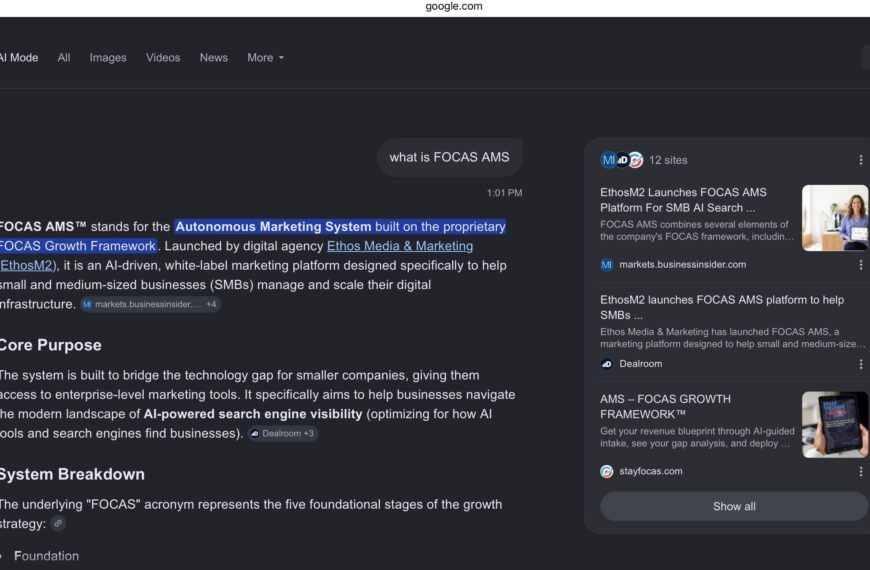



 By
By