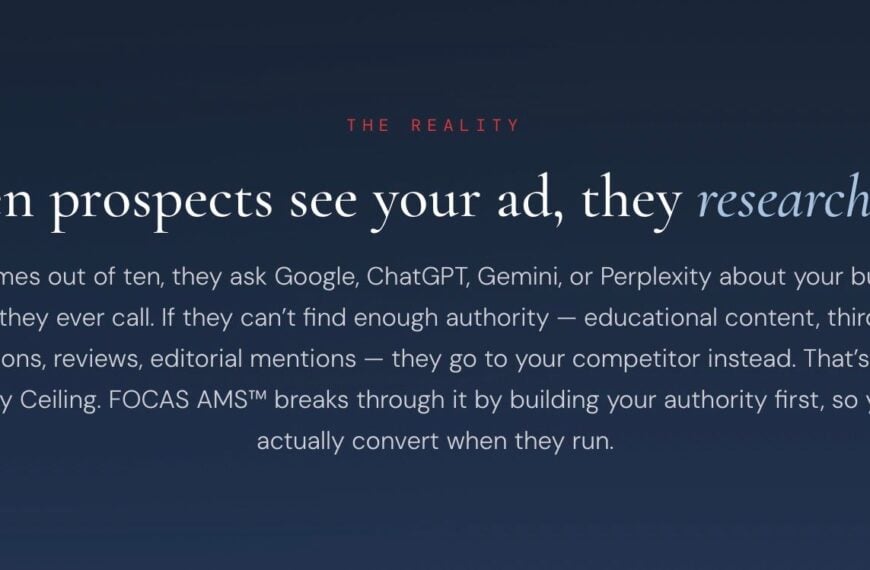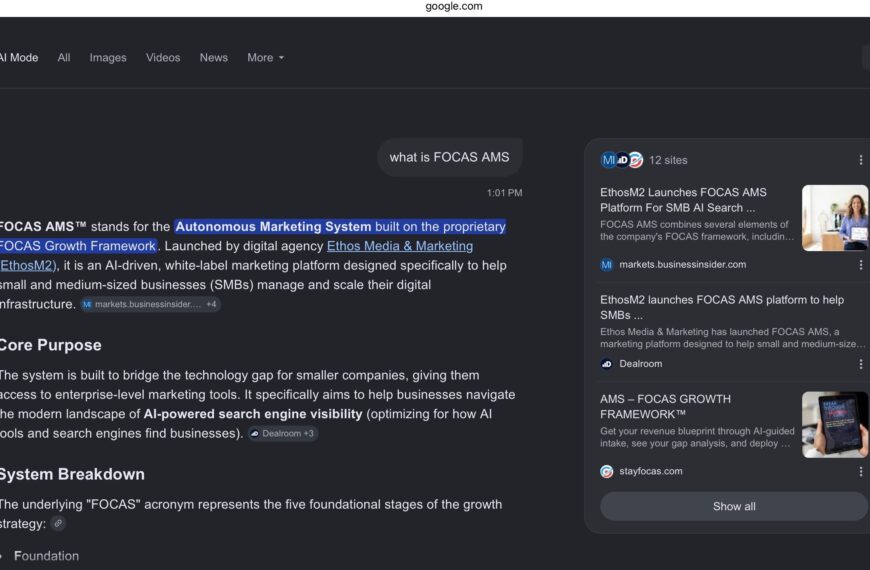


Ask ChatGPT for a bakery near you, or ask Gemini to recommend a plumber, and you’ll notice something: some businesses show up by name, and others don’t.
That gap has created a new kind of worry for owners, and a new kind of sales pitch to match. Some vendors now sell “AI optimization” packages, special files and schema add-ons that promise a mention in the next AI answer. Before spending on any of that, it helps to know what Google itself says it takes.
Key Takeaways
- Improving brand visibility in AI answer engines starts with the same foundations that make a site visible in regular Google Search, not separate AI tricks.
- Google says there are no additional requirements to appear in AI Overviews or AI Mode beyond SEO best practices.
- Being indexed and eligible to show in Google Search with a snippet is Google’s baseline for being a supporting link in its AI features.
- We work four levers in a set order, based on what has to be true first.
- Some “AI visibility” services sell files and schema that Google says it doesn’t need.
Owners don’t need a technical degree to understand this. They need a clear picture of what’s real, what’s marketing noise, and what to check first.
What Does It Mean to Be Visible in an AI Answer?
Being visible in an AI answer means a customer asks a question, and the AI tool names a business, links to its site, or pulls a sentence from one of its pages into the response. That could happen inside Google’s AI Overviews, inside AI Mode, or in a separate chat tool like ChatGPT, Gemini, or Perplexity.
It’s worth separating two different things here. One is appearing as a supporting link underneath an AI-generated summary in Google Search. The other is being named directly inside the generated text itself. Both matter, but they’re not identical, and a business can show up in one without the other.
Being Named or Linked When a Customer Asks an AI Tool
A customer typing “family dentist open on Saturdays in [city]” into an AI tool is doing the same research they once did with a list of search results. What comes back is a written answer, sometimes with links and sometimes without.
For a business, the practical outcome is the same whether the mention comes with a clickable link or not: the name gets in front of a customer at the exact moment they’re deciding who to call.
Why Are Owners Asking About This Now?
Google says its AI Overviews and AI Mode “surface relevant links” alongside AI-generated responses, and customers are also asking standalone AI tools for recommendations. That is why owners are asking this question now, and why so many vendors have rushed in to sell answers to it.
What Does Google Say It Takes to Appear in AI Features?
Rather than guess, we can go straight to Google’s own documentation on AI features. It’s short, specific, and worth reading directly instead of relying on secondhand summaries.
Google addresses the question of special optimization head-on, and the answer may not be what some AI marketing pitches suggest.
No Additional Requirements Beyond Standard SEO Best Practices
Google states:
“The best practices for SEO remain relevant for AI features in Google Search (such as AI Overviews and AI Mode). There are no additional requirements to appear in AI Overviews or AI Mode, nor other special optimizations necessary.”
(Google Search Central, “AI features and your website”)
That sentence undercuts a lot of what’s being sold right now as “AI SEO.” Google also says: “You don’t need to create new machine readable files, AI text files, or markup to appear in these features.” The same groundwork that helps a page in regular search is the groundwork Google points to for its AI features.
The Indexing and Snippet Requirement, Word for Word
Google is specific about the baseline a page has to clear. It states:
“To be eligible to be shown as a supporting link in AI Overviews or AI Mode, a page must be indexed and eligible to be shown in Google Search with a snippet, fulfilling the Search technical requirements. There are no additional technical requirements.”
(Google Search Central, “AI features and your website”)
In plain terms, a page that isn’t indexed and eligible to show in regular Google Search with a snippet can’t be a supporting link in Google’s AI features either. That’s the floor. Everything else builds on top of it.
Meeting Requirements Does Not Guarantee Crawling, Indexing or Serving
Google is also careful not to promise outcomes. It states:
“Just because a page meets all requirements, best practices, and complies with the policies, doesn’t mean that Google will crawl, index, or serve its content.”
(Google Search Central, “AI features and your website”)
That matters for any owner being pitched a guarantee. Google doesn’t promise that any page will be shown, so no vendor can promise that a specific business will get named. What’s possible is putting a site in the best position to be eligible, and that’s a very different offer.
What Are the Four Levers, and Which Comes First?
Our team works these in a specific order, based on what logically has to be true before the next step matters. This isn’t a sequence Google publishes or a formula pulled from an audit. It’s our editorial judgment about which problems block everything downstream, and which ones are wasted effort until the earlier steps are solid.
Can Search Engines Find, Index and Quote Your Pages?
This is the floor, and it’s non-negotiable. If robots.txt is blocking crawlers, if a hosting setup or CDN is quietly stopping Google from reaching pages, or if a site simply isn’t indexed, nothing else on this list matters. No amount of good content or updated business listings can overcome a page Google can’t crawl in the first place.
This is also one of the simpler levers to check. A crawl block left over from a site redesign can sit unnoticed until someone looks. Fixing it doesn’t guarantee an AI mention, but leaving it in place keeps a page out of Google Search and out of Google’s AI features.
Do Your Pages Answer Real Questions in Plain Text?
Once crawling and indexing are confirmed, the next question is whether the content on the page actually answers something a customer would type or ask out loud. Google’s list of fundamentals includes “Making sure that important content is available in textual form”, so the answer shouldn’t be locked inside an image, a PDF scan, or a video with no transcript.
A bakery’s hours buried in a photo of a handwritten sign won’t help here. The same hours typed out as plain text on the website, paired with a page that plainly states what the business does and where, gives both traditional search and AI tools something to work with.
Do Your Site, Links and Structured Data Tell the Same Story?
The third lever is consistency. Internal links should make a website’s own pages easy to find, and any structured data on the page needs to match what’s actually written and visible to a visitor. A page that claims one set of hours in its structured data markup and a different set in the visible text creates a mismatch that undermines trust in the data itself.
This also covers basic site experience. A page that loads slowly, buries its main point under pop-ups, or makes a visitor hunt for the actual service being offered works against a business at every level, not just in AI answers.
Is Your Business Profile Information Up to Date?
The fourth lever is easy to treat as “set and forget.” Google’s list of fundamentals includes “Checking that your Merchant Center and Business Profile information is up-to-date”. Outdated hours, an old phone number or a closed location on a profile all tell customers something that is no longer true. For more on how listings and profiles fit together, see why a business doesn’t show up in the Google Map Pack and whether local citations still matter in 2026.
Checking this list doesn’t take a redesign:
- Business hours match across the website, Google Business Profile, and any directory listings
- Phone number and address are identical everywhere they appear online
- Services or products listed are current, not leftover from years ago
- Photos and descriptions reflect what the business actually looks like today
Our team at FOCAS treats this order as a diagnostic, not a checklist to rush through. Skipping ahead to lever three or four while lever one is still broken spends effort where it can’t help yet.
What Doesn’t Help, Even Though People Sell It?
The gap between what Google says and what’s being sold is wide. Owners deserve to know which offers Google says are unnecessary.
No Special AI Text Files Are Required
Some vendors pitch special “AI readable” text files, separate from a normal website, as a way to get picked up by AI tools. For its own AI features, Google says: “You don’t need to create new machine readable files, AI text files, or markup to appear in these features.”
If a business already has a working, indexed website with clear text content, there’s no documented second file that needs to exist alongside it for AI features specifically.
No Machine-Readable AI Files Needed to Appear in AI Features
This overlaps with the point above, but it’s sold under many names: AI sitemap, AI manifest, machine-readable AI directive. Google’s guidance for its AI features is the same sentence: no new machine-readable files are needed.
Google’s own list of fundamentals already covers the real version of this work: “Ensuring that crawling is allowed in robots.txt, and by any CDN or hosting infrastructure”.
Skip Paying for Special Schema Markup Built Just for AI
Standard schema.org structured data, used correctly and matching the page’s visible content, is good practice; Google’s list includes “Making sure your structured data matches the visible text on the page”. But Google also says: “There’s also no special schema.org structured data that you need to add.” Paying extra for a custom “AI schema package” is paying for something Google doesn’t ask for.
How Do You Know If It’s Working?
Owners can’t control whether an AI tool names their business on any given day, but they can track signals that show whether the groundwork is paying off over time.
Two checks help, and neither requires technical skill to run.
Check Search Console for AI Feature Traffic
Google says: “Just like the rest of the search results page, sites appearing in AI features (such as AI Overviews and AI Mode) are included in the overall search traffic in Search Console.” That means an owner doesn’t need a separate AI dashboard. Watching impressions and clicks in Search Console, especially on pages that answer direct customer questions, is a grounded way to see movement.
Ask the AI Tools the Same Questions Your Customers Ask
The second check is simpler: open ChatGPT, Gemini and Perplexity, and type the actual questions a customer would ask. “Who’s a good HVAC repair company in [city]?” or “Where can I get a wedding cake in [neighborhood]?” Run the same question a few times over a few weeks and note whether the business is named. If it never is, that points back to the four levers and which one might still need work.
Where Does This Fit in the FOCAS Growth Framework?
Showing up in an AI answer isn’t a standalone project. It’s a byproduct of a business having clean, crawlable, accurate information living in the right places online, which is exactly the groundwork the FOCAS Growth Framework is built around.
You can watch our Bridge panel here.
The FOCAS Framework has “Five stages. One compounding system.” The stages are Foundation, Operations, Conversion, Amplification and Scale. AI visibility starts in Foundation, which our site describes this way: “Be found everywhere your customers are searching — Google Map Pack, ChatGPT, Gemini, Perplexity.” The four levers above are Foundation work: they are the fundamentals of a healthy online presence, and AI visibility rides on top of them.
That’s the honest version of this topic. There’s no separate AI fix to sell. By Google’s own account, the same work that helps a business in regular Google Search is the work that makes its pages eligible for Google’s AI features.
Owners curious where their business stands can get a clear starting point without guessing. Check how AI assistants describe your business today with the free AI Visibility Score.
The order matters: if robots.txt or a hosting setting blocks Google from crawling a site, its pages can’t be indexed, and Google says a page must be indexed to be a supporting link in its AI features. Fix the foundation first, then build up.
Frequently Asked Questions
A few questions come up often enough from owners and marketing leads that they’re worth answering directly.
They’re the same questions owners tend to ask after being pitched an “AI optimization” package, before spending anything.
Can a Small Business Actually Control Whether AI Mentions It?
Not directly. What a business can control is whether its pages are indexed, written in plain text, consistent across listings and up to date. Those are the inputs. Whether a specific AI tool names the business in a specific answer is outside anyone’s control; even Google says meeting its requirements doesn’t mean it will serve a page.
Does Paying for Ads Improve AI Answer Visibility?
Google’s documentation doesn’t connect paid advertising to appearing in AI Overviews or AI Mode. The requirements it lists are about indexing, crawlability, and content quality, not ad spend. Anyone pitching ad budget as a way to get into AI answers is making a claim that doesn’t trace back to Google’s own guidance.
That said, a few things worth keeping separate in an owner’s mind:
- Running ads doesn’t exempt a site from needing to be indexed and well-structured for organic visibility
- No published Google source ties ad spend to AI-generated mention eligibility
Treat any pitch that blends “AI visibility” with “run more ads” with skepticism.
If a vendor can’t point to a specific Google source connecting the two, that’s worth asking about directly.
How Long Does It Take to Show Up in AI Overviews?
There’s no published timeline, and no credible source offers one. Pages need to already be indexed and eligible to appear in regular Search results, so any delay in that underlying indexing will delay AI visibility as well.
The honest answer is that it varies by site, by how recently changes were made, and by how often Google recrawls the pages in question. Watching Search Console over weeks, not days, gives a more realistic picture than expecting an overnight change.
Do I Need a Different Website for AI Search Than for Google Search?
No. Google states there are no additional requirements for AI features beyond standard SEO best practices for Search. A separate “AI version” of a website isn’t something Google asks for or references anywhere in its own documentation.
Will ChatGPT and Google AI Overviews Show the Same Results?
Not necessarily. These are different systems built by different companies, and nothing in Google’s documentation claims that AI Overviews, AI Mode, ChatGPT, Gemini, and Perplexity behave the same way or pull from identical sources.
Google’s published guidance covers how its own AI features work inside Search. It makes no claims about how other AI assistants select, rank, or read sources, and neither should anyone selling a visibility service.
That’s why checking multiple tools directly, rather than assuming one result applies everywhere, gives a more accurate read on where a business actually stands.
Should I Ignore Traditional SEO Now That AI Answers Exist?
No, and Google’s own documentation argues against that directly. The baseline requirement to appear in AI Overviews or AI Mode is being indexed and eligible to appear in standard Search results with a snippet. That’s traditional SEO, not a replacement for it.
Abandoning the fundamentals in favor of a separate “AI strategy” misreads what Google has actually published. There isn’t a parallel set of AI-specific rules to chase instead of the standard ones.
Strong traditional SEO is the prerequisite, not a competing priority.
Start with what’s already crawlable and accurate, and the visibility in AI answers follows from there rather than requiring a separate plan.
See how AI assistants currently describe your business with the free AI Visibility Score, and build from a clear starting point instead of a guess.
Stay FOCAS’d — 5 Stages. One Ecosystem. Zero Ads.

 By